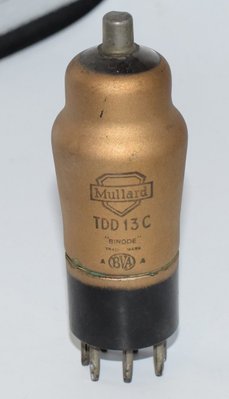
Introduction and History
The Mullard TDD13C is an indirectly heated double-diode-triode valve manufactured by Mullard, one of Britain's most respected valve producers. Designed primarily for use as a combined detector and low-frequency (L.F.) amplifier with automatic volume control (AVC) capability, the TDD13C was intended for DC/AC mains receivers of the 1930s era. The datasheet reference number 1537 places its documentation firmly in the mid-to-late 1930s period, during the golden age of European radio receiver development.
The 'TDD' designation in Mullard's nomenclature indicates a Triode-Double-Diode configuration, while the '13C' suffix denotes the 13-volt heater series — a characteristic of valves designed for series-heater chains in AC/DC (universal) mains receivers. These receivers were designed to operate without a mains transformer, with the valve heaters wired in series across the mains supply. The 13-volt heater rating was a common standard in European valve design for this purpose, allowing efficient distribution of the mains voltage across a chain of valves.
The TDD13C features a metallised glass bulb envelope, which served as an electrostatic shield to reduce hum pickup and stray capacitive coupling — an important consideration in the compact chassis designs of the period. The combination of two diodes and a triode in a single envelope was an elegant solution that reduced component count, chassis space, and cost in consumer radio receivers.
Technical Specifications and Design
Heater Characteristics
| Parameter | Symbol | Value |
|---|---|---|
| Heater Voltage | Vf | 13.0 volts |
| Heater Current | If | 0.2 amp |
| Heating Time | — | 60 seconds |
Physical Dimensions
| Parameter | Value |
|---|---|
| Overall Length | 128 mm |
| Overall Diameter | 45 mm |
| Bulb Finish | Metallised |
| Base Type | 7-pin base with top cap |
Triode Operating Characteristics
| Parameter | Symbol | Value |
|---|---|---|
| Normal Anode Voltage | Vaw | 200 volts |
| Anode Current (at −Vg1 = 5.0) | Iaw | 4.0 mA |
| Grid Voltage (at Ia = 4.0 mA) | −Vg1w | 5.0 volts |
| Mutual Conductance | Sw (gm) | 2.0 mA/V |
| Anode Impedance (Plate Resistance) | Riw (rp) | 13,500 ohms |
| Amplification Factor | Gw (μ) | 27 |
| Cathode Bias Resistor | Rk | 1,250 ohms |
Operating Data as R.C. Amplifier
| Parameter | Symbol | Value |
|---|---|---|
| Anode Voltage (Line) | Va | 200 volts |
| Anode Resistance | Ra | 160,000 ohms |
| Bias Voltage | −Vg1 | 3.6 volts |
| Anode Current | Ia | 0.65 mA |
| Bias Resistance | Rk | 5,500 ohms |
| Amplification Factor (Stage Gain) | G | 19.5 |
| Maximum Output Volts (D = 5%, 2nd Harmonic) | Vo | 37 V R.M.S. |
Absolute Maximum Ratings (Limits)
| Parameter | Symbol | Value |
|---|---|---|
| Maximum Anode Voltage | Vamax | 200 volts |
| Maximum Anode Dissipation | Wamax | 1.5 watts |
| Maximum Diode Anode Voltage (Peak) | Vdmax | 200 volts |
| Maximum Diode Anode Current | Idmax | 0.8 mA |
| Maximum Cathode Current | Ikmax | 10.0 mA |
| Maximum Resistance in Grid Circuit | Rg1Amax | 1.5 megohms |
| Maximum Voltage — Heater to Cathode | Vfkmax | 125 volts |
| Maximum Resistance — Heater to Cathode | Rfkmax | 20,000 ohms |
| Range of Grid Voltage for 1 μA Grid Current | — | −0.2 to −0.8 volt |
Interelectrode Capacitances
| Parameter | Symbol | Value |
|---|---|---|
| Grid-Cathode | Cgk | 3.5 μμF |
| Anode-Cathode | Cak | 2.9 μμF |
| Cathode-Diode (1) | Ckd1 | 2.5 μμF |
| Cathode-Diode (2) | Ckd2 | 3.25 μμF |
| Diode (1)-Diode (2) | Cd1d2 | 0.3 μμF |
| Diode (1)-Control Grid | Cd1g | <0.0015 μμF |
| Diode (2)-Control Grid | Cd2g | <0.0015 μμF |
Pin Connections
The TDD13C uses a 7-pin base with a top cap connection. Viewed from the free end of the pins (bottom of the valve):
| Pin Number | Connection |
|---|---|
| 1 | Diode (1) |
| 2 | Metallisation (screen) |
| 3 | Diode (2) |
| 4 | Heater |
| 5 | Heater |
| 6 | Cathode |
| 7 | Anode |
| Top Cap | Control Grid (G1) |
The use of a top cap for the control grid was standard practice in this era, providing maximum physical separation between the grid connection and the other electrodes to minimise stray capacitance and feedback — particularly important in detector and amplifier stages where unwanted coupling could cause instability or oscillation.
Applications and Usage
The Mullard TDD13C was designed for a very specific and important role in 1930s radio receiver design. Its primary applications included:
Combined Detector and Audio Amplifier
The most common application was as a combined AM detector and first audio amplifier stage. One or both diodes would be used for signal detection (demodulation of the AM carrier), while the triode section provided the first stage of audio frequency amplification. This was an extremely efficient use of a single valve envelope, reducing the total valve count in a receiver.
Automatic Volume Control (AVC)
The datasheet specifically mentions the application of automatic volume control. In a typical AVC circuit, one diode would serve as the signal detector while the second diode would be dedicated to generating the AVC bias voltage. This DC voltage, derived from the strength of the received signal, would be fed back to the IF and RF amplifier stages to reduce their gain on strong signals, thereby maintaining a more constant audio output level. The extremely low capacitive coupling between the diodes and the control grid (less than 0.0015 μμF for both Cd1g and Cd2g) was critical for preventing unwanted interaction between the detection/AVC circuits and the triode amplifier section.
AC/DC Mains Receivers
With its 13-volt, 0.2-amp heater, the TDD13C was specifically designed for series-heater chains in transformerless AC/DC receivers. The 0.2-amp heater current was a standard value that allowed it to be connected in series with other 0.2-amp valves in the same receiver. The 60-second heating time and the 125-volt maximum heater-to-cathode voltage rating were important considerations in series-heater designs where significant voltage differences could exist between the heater and cathode of individual valves.
R.C. Coupled Amplifier
The datasheet provides detailed operating data for the triode section used as a resistance-capacitance coupled amplifier. With a 160,000-ohm anode load resistor and 200-volt supply, the stage could deliver a gain of 19.5 with a maximum output of 37 V R.M.S. at 5% second harmonic distortion. The 5,500-ohm cathode bias resistor provided self-biasing at −3.6 volts, simplifying the circuit design by eliminating the need for a separate bias supply.
Sound Characteristics
While the TDD13C was designed primarily as a radio receiver component rather than a dedicated audio amplifier valve, its triode section possesses characteristics that contribute to a distinctive sonic signature when evaluated by modern standards:
The triode section, with its amplification factor (μ) of 27 and plate resistance of 13,500 ohms, falls into the medium-mu triode category. This places it in a similar performance class to other European detector triodes of the era. The mutual conductance of 2.0 mA/V, while modest by later standards, provides adequate gain for voltage amplifier duties.
In terms of tonal character, medium-mu triodes of this type tend to produce a warm, smooth midrange with gentle, predominantly even-order harmonic distortion when driven into non-linearity. The relatively high plate resistance of 13,500 ohms means that when used with high-impedance loads (such as the specified 160,000-ohm anode resistor), the tube operates well within its linear region, producing clean amplification with minimal coloration.
The 1.5-watt maximum anode dissipation limits the tube to small-signal applications, where it would function as a voltage amplifier rather than a power stage. In this role, the TDD13C would be expected to deliver a detailed, articulate sound with the characteristic warmth associated with indirectly heated triodes. The metallised envelope contributes to low noise operation by providing effective electrostatic shielding.
The diode sections, when used for detection, would contribute to the overall sonic character of a receiver. Diode detection is inherently linear for signals well above the diode's conduction threshold, contributing to clean, undistorted audio recovery from AM signals.
It should be noted that the TDD13C's sonic characteristics are best understood in the context of its intended application in 1930s radio receivers, where it formed part of a complete signal chain rather than serving as a standalone audio component.
Equivalent or Substitute Types
The TDD13C belongs to a family of European double-diode-triode valves designed for the 13-volt heater series. Finding exact equivalents requires matching the heater voltage and current, base type, pinout, and electrical characteristics. The following types may be considered:
- Mullard TDD13: An earlier variant in the same family. Builders should verify pinout compatibility and electrical specifications, as earlier versions may differ in ratings or base configuration.
- Other European 13V DDT types: Various European manufacturers (Philips, Valvo, Tungsram) produced double-diode-triodes for the 13-volt series-heater market. However, exact pin-for-pin equivalence should be confirmed against manufacturer data, as base connections were not always standardised across manufacturers in this era.
Important note: The TDD13C uses a specific 7-pin base with top cap grid connection. Any substitute must match this physical configuration exactly. The 13-volt heater series is less common than the more widespread 4V or 6.3V families, which significantly limits the pool of potential substitutes. Builders should exercise caution and verify all specifications before attempting substitution. The author recommends consulting comprehensive European valve equivalence guides (such as those published by Philips/Mullard) for confirmed interchangeable types, as unverified substitutions could result in damage to the valve or the equipment.
Notable Characteristics
- Series-heater design: The 13.0V, 0.2A heater is specifically designed for series-heater chains in AC/DC receivers, a common European design approach that eliminated the need for a costly mains transformer.
- Extremely low diode-to-grid capacitance: Both Cd1g and Cd2g are specified at less than 0.0015 μμF, ensuring excellent isolation between the diode detection/AVC circuits and the triode amplifier section. This was a key design achievement that prevented unwanted feedback and interaction between the different functional sections of the valve.
- Metallised envelope: The metallised bulb finish provides electrostatic shielding, reducing hum pickup from external fields — particularly important in transformerless AC/DC receivers where the chassis might be connected to one side of the mains supply.
- High heater-to-cathode voltage rating: The 125-volt maximum Vfk rating accommodates the significant voltage differences that can exist between heater and cathode in series-heater designs, where the heater chain may place individual valves at substantial potentials above chassis ground.
- 60-second heating time: The relatively long warm-up period is typical of indirectly heated valves of this era and was an important consideration in receiver design, as other circuit elements needed to accommodate the delay before the valve reached operating temperature.
- Moderate amplification factor: The μ of 27 provides a good balance between voltage gain and linearity for detector/first audio amplifier applications, avoiding the higher distortion that can accompany very high-mu triodes.
- Grid current onset range: The specification that 1 microamp of grid current flows between −0.2 and −0.8 volts of grid voltage provides important design information for ensuring the triode operates in its grid-negative (Class A) region without grid current distortion.
Usage in the Audio Community
The Mullard TDD13C occupies a niche position in the modern audio community. Unlike more celebrated audio valves such as the 12AX7, EL34, or 300B, the TDD13C was never designed as a dedicated high-fidelity audio component. Its primary domain was the consumer radio receiver market of the 1930s, and its legacy is most closely tied to the restoration and preservation of vintage radio equipment.
Vintage Radio Restoration
The most significant use of the TDD13C in the modern era is in the restoration of original 1930s Mullard-equipped radio receivers. Collectors and restorers of vintage British and European radios seek out working examples of the TDD13C to maintain the authenticity of their restorations. As these valves become increasingly scarce, finding tested, functional examples commands a premium among the vintage radio community. The AVO valve tester, referenced in the product listing data, remains one of the most trusted instruments for verifying the condition of these vintage valves.
Experimental Audio Projects
A small but dedicated community of audio experimenters and DIY builders explores unusual and obscure valve types for unique amplifier and preamplifier projects. The TDD13C's triode section, with its μ of 27 and 2.0 mA/V transconductance, can serve as a capable voltage amplifier stage in experimental preamplifier designs. The integrated diode sections could potentially be repurposed for signal routing, clipping, or other creative audio processing functions in experimental circuits.
Challenges for Modern Audio Use
Several factors limit the TDD13C's adoption in mainstream audio applications:
- Heater voltage: The 13-volt heater is incompatible with standard 6.3V or 12.6V heater supplies found in most audio equipment, requiring a dedicated or custom power supply arrangement.
- Scarcity: As a pre-war European valve type, NOS (New Old Stock) examples are rare and becoming increasingly difficult to source.
- Limited power handling: The 1.5-watt maximum anode dissipation restricts the valve to small-signal applications only.
- Obsolete base type: The 7-pin base with top cap connection requires specific sockets that are less readily available than the ubiquitous octal or noval types used in later designs.
Collector Interest
The TDD13C holds value as a collectible item representing an important era in European valve technology. The Mullard brand carries significant cachet among valve collectors, and pre-war types with metallised envelopes are particularly prized for their historical significance and distinctive appearance. Complete, boxed examples in original Mullard packaging are especially sought after by collectors.
For those interested in exploring the sonic character of 1930s European triode technology, the TDD13C offers an authentic window into the sound of the era — albeit one that requires dedication, specialised knowledge, and appropriate supporting circuitry to bring to life in a modern audio context.