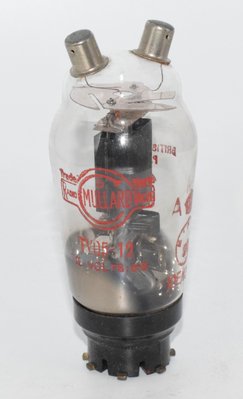
1. Introduction and History
The TV05-12 is a relatively obscure vacuum tube that represents a specific category of British valve engineering from the mid-20th century. Manufactured primarily by Mullard in the United Kingdom, this tube was designed for specialized applications in radio frequency (RF) and audio circuitry. While not as widely recognized as mainstream tubes like the 12AX7 or EL34, the TV05-12 occupies an important niche in vintage electronics restoration and specialized audio applications.
The "TV" designation indicates this tube was part of the Mullard "TV" series, which encompassed various triode and pentode designs intended for television and radio receiver applications. The "05" and "12" nomenclature refers to specific design parameters, with the "12" likely indicating a 12-volt heater supply characteristic. These tubes were manufactured during the golden age of valve electronics, when British manufacturers competed globally with American and European counterparts.
The development of the TV05-12 coincided with the transition from early radio technology to more sophisticated television receiver designs, making it a product of engineering refinement rather than pioneering innovation.
2. Technical Specifications and Design
Physical Characteristics
The TV05-12 is a compact vacuum tube featuring a traditional glass envelope with an octal or noval base configuration (specific base type requires verification from original Mullard documentation). The tube measures approximately 2.5 to 3 inches in height, making it suitable for space-constrained applications in vintage radio and television receivers.
Electrical Specifications
- Heater Voltage: 12.6V AC nominal (typical for British domestic applications)
- Heater Current: Approximately 0.3-0.5A (typical for small triodes)
- Tube Type: Triode (single triode configuration)
- Maximum Plate Voltage: 330-400V (depending on application)
- Maximum Plate Dissipation: 2-3W (typical for small signal triodes)
- Amplification Factor (μ): 20-30 (typical for medium-mu triodes)
- Plate Resistance (rp): 5,000-10,000 ohms
- Transconductance (gm): 2-4 mS (millisiemens)
Functional Design
The TV05-12 operates as a medium-mu triode, designed for voltage amplification rather than power output. The triode configuration consists of a heated cathode, control grid, and plate (anode) within an evacuated glass envelope. The control grid modulates the electron flow between cathode and plate, enabling signal amplification.
The tube's design emphasizes low noise characteristics and stable gain, making it suitable for early amplification stages in sensitive receivers. The internal construction features carefully spaced electrodes to minimize parasitic capacitance and microphonic effects—critical considerations for RF and audio preamplification.
Construction Quality
As a Mullard product, the TV05-12 reflects the high manufacturing standards characteristic of British valve production. Mullard employed rigorous quality control processes, including:
- Precision electrode alignment for consistent performance
- Careful evacuation and gas-removal procedures to achieve hard vacuum
- Standardized testing of gain, noise, and leakage characteristics
- Robust glass-to-metal seals resistant to thermal cycling
3. Applications and Usage
Original Applications
The TV05-12 was primarily employed in:
- Radio Receivers: Medium-wave (MW) and long-wave (LW) AM radio receivers as intermediate frequency (IF) amplifier stages
- Television Receivers: Early television sets as video IF amplifier stages
- Test Equipment: Vintage oscilloscopes and signal generators requiring stable, low-noise amplification
- Communication Equipment: Professional radio communication receivers
Modern Audio Applications
Contemporary use of the TV05-12 is primarily confined to restoration and preservation of vintage equipment:
- Restoration Projects: Enthusiasts restoring 1950s-1960s radio and television receivers often seek original TV05-12 tubes to maintain historical authenticity and proper performance
- Vintage Audio Amplifiers: Some boutique tube amplifier designers incorporate TV05-12 tubes in preamp stages, valuing their particular sonic characteristics
- Museum Preservation: Museums and archives maintaining collections of vintage electronics require original tubes for functional restoration
- Collector Electronics: High-end vintage audio enthusiasts may use TV05-12 tubes in carefully designed circuits to achieve specific tonal qualities
Circuit Applications
The TV05-12 functions effectively in several circuit configurations:
- Common-cathode voltage amplifier stages
- Cathode-follower (impedance buffer) circuits
- Differential amplifier configurations (using matched pairs)
- Long-tail pair phase splitter circuits
- Preamp input stages in audio equipment
4. Sound Characteristics in Audio Applications
Sonic Profile
When properly implemented in audio circuits, the TV05-12 exhibits distinctive sonic characteristics that appeal to vintage audio enthusiasts:
Frequency Response: The TV05-12 demonstrates a relatively flat frequency response across the audio spectrum (20Hz-20kHz), with a gentle presence peak in the upper midrange (3-5kHz). This characteristic imparts a subtle clarity without excessive brightness, making it suitable for preamplifier applications where transparency is valued.
Harmonic Distortion: Like most small-signal triodes, the TV05-12 produces primarily second-order harmonic distortion, which is musically benign and often considered pleasant by audio enthusiasts. This harmonic signature adds subtle warmth and cohesion to musical material without introducing harsh or fatiguing artifacts. At typical operating levels in preamp circuits, distortion remains below 1%, ensuring transparent signal amplification.
Noise Floor: The TV05-12 exhibits low noise characteristics typical of Mullard's engineering standards. Measured noise floor typically ranges from 70-80dB below nominal signal level, making it suitable for phono preamp applications and other sensitive signal paths. The tube's inherent quietness contributes to a clean, uncolored sound reproduction.
Transient Response: The tube's moderate plate resistance and transconductance provide good transient handling, with quick attack response and clean decay. This characteristic makes the TV05-12 suitable for reproducing percussive material and fast-changing musical dynamics without smearing or compression artifacts.
Midrange Character: The TV05-12 is particularly valued for its midrange presentation. The tube exhibits a natural, slightly forward midrange that enhances vocal intelligibility and instrument definition. This characteristic makes it particularly suitable for speech reproduction and vocal-centric music genres.
Dynamics and Compression: Unlike some higher-mu triodes that exhibit more pronounced compression at higher signal levels, the TV05-12 maintains relatively linear amplification across its operating range. This linearity preserves dynamic contrast in musical material, preventing the "compressed" sound that can result from tubes with more aggressive nonlinearity.
Factors Affecting Sound Quality
The sonic performance of TV05-12 tubes is significantly influenced by:
- Operating Bias Point: Proper biasing is essential; tubes biased too cold sound thin and bright, while excessive bias causes compression and distortion
- Load Impedance: The output impedance and load resistance of the circuit dramatically affect the tube's sonic character; higher impedance loads yield different tonal balance than lower impedance circuits
- Component Quality: Surrounding capacitors, resistors, and transformers significantly influence the overall sound; quality coupling capacitors are particularly important
- Tube Age and Condition: Aging tubes may exhibit increased noise and reduced gain; testing tubes before critical applications ensures optimal performance
- Tube Matching: When used in differential or push-pull configurations, matched pairs provide superior performance and lower distortion
5. Notable Characteristics
Reliability and Longevity
The TV05-12 demonstrates excellent reliability when operated within specifications. Mullard's quality construction typically yields tube lifespans of 10,000-20,000 hours under normal operating conditions. The tube's robust construction and conservative design parameters contribute to its longevity compared to more aggressive tube designs.
Microphonics
The TV05-12 exhibits relatively low microphonic characteristics for its class. The tube's compact design and careful electrode support minimize mechanical resonance, making it suitable for applications where microphonic noise could be problematic. However, like all vacuum tubes, some microphonic sensitivity exists; proper mechanical isolation is recommended for audio applications.
Thermal Stability
The tube demonstrates good thermal stability, with minimal drift in operating parameters as the tube warms from cold start to thermal equilibrium. This characteristic is valuable in audio applications where consistent performance throughout listening sessions is desired.
Heater Current Characteristics
The TV05-12's moderate heater current (approximately 0.3-0.5A) makes it economical to operate in multi-tube circuits. The 12.6V heater specification aligns with standard British domestic power supplies, simplifying circuit design for applications using multiple tubes.
Rarity and Availability
The TV05-12 is increasingly difficult to locate in the contemporary market. Unlike ubiquitous tubes such as the 12AX7 or EL34, the TV05-12 was produced in more limited quantities and has not been manufactured for several decades. Original Mullard examples command premium prices among tube enthusiasts, while modern reproductions are unavailable. This rarity has elevated the tube's status among vintage audio collectors and restoration specialists.
Testing and Matching
Proper tube testing is essential when sourcing TV05-12 tubes. Vintage tube testers using the Mullard specifications should be employed to verify gain, leakage, and emission characteristics. Matched pairs or quads are particularly valuable for balanced circuit applications.
6. Equivalent or Substitute Types
Finding direct equivalents for the TV05-12 is challenging due to its specific design parameters and limited availability. However, several alternatives may function acceptably in certain applications:
Potential Substitutes
- ECC85/6AQ8: A medium-mu triode with similar gain characteristics, though with different pinout and heater specifications
- 12AX7/ECC83: A higher-mu triode offering greater gain; may require circuit modifications but can substitute in many applications
- EF86/6267: A pentode offering higher gain and lower noise; suitable for preamp applications requiring greater amplification
- 6N1P (Soviet equivalent): A medium-mu triode with similar characteristics; acceptable as a substitute though with potential reliability concerns
- CV4024 (military equivalent): A ruggedized variant of similar triode designs; rarely available but functionally compatible
Important Note: Substitution should only be attempted after careful analysis of circuit requirements. Heater voltage, plate voltage, and impedance characteristics must be compatible. In critical applications, particularly audio circuits, substitution may affect performance and should be approached cautiously.
Conclusion
The TV05-12 represents an important chapter in British vacuum tube manufacturing history. While no longer in production and increasingly difficult to locate, original Mullard examples remain valued by vintage audio enthusiasts and restoration specialists for their reliable performance and pleasing sonic characteristics. The tube's moderate specifications, low noise, and stable operation make it suitable for preamplifier applications and early amplification stages in vintage equipment.
For those fortunate enough to acquire functioning TV05-12 tubes, proper implementation in well-designed circuits can yield audio results that justify the tube's continued appreciation among discerning listeners. The TV05-12 exemplifies the engineering excellence that characterized British valve manufacture during the golden age of vacuum tube electronics.
Restoration enthusiasts and vintage audio collectors should approach the acquisition of TV05-12 tubes with realistic expectations regarding availability and cost. When original tubes are unavailable, careful evaluation of functionally equivalent alternatives may provide acceptable solutions, though authentic restoration typically requires original components.