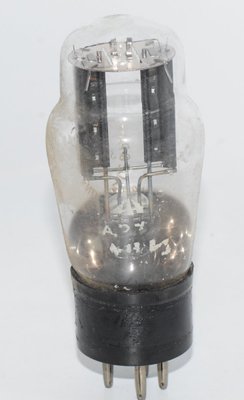
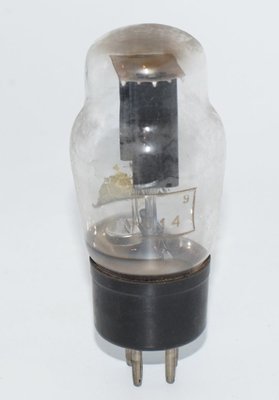
1. Introduction and History
The Osram U14 is a directly heated, full-wave rectifier valve manufactured by the General Electric Company (GEC) under the Osram Valves brand in England. Designed for use in mains-powered equipment, the U14 incorporates a dual electrode (dual-anode) system within a single glass envelope, enabling full-wave rectification of both half-cycles of the AC mains waveform when fed through a suitable power transformer.
The U14 was developed during the golden era of British valve manufacturing, when GEC/Osram produced a comprehensive range of receiving and rectifying valves for domestic radio receivers, amplifiers, and industrial equipment. It belongs to the same family as the Osram U12, sharing the same filament ratings but offering higher voltage capability, making it suitable for more demanding power supply applications. The valve was designed for long life and constant emission when operated at its rated voltage — a hallmark of Osram's engineering philosophy that prioritised reliability and consistency.
As a directly heated rectifier, the U14 uses its filament as the cathode, a design approach that was standard for rectifier valves of this period. This construction offers the advantage of rapid warm-up and robust emission characteristics, though it requires careful attention to filament supply design to avoid hum injection into the DC output.
2. Technical Specifications and Design
Electrical Ratings
| Parameter | U14 Value | U12 Value (for comparison) |
|---|---|---|
| Filament Voltage (Vf) | 4.0 V | 4.0 V |
| Filament Current (If) | 2.5 A (approx.) | 2.5 A (approx.) |
| Anode Volts R.M.S. (each anode), Max. | 500 V | 350 V |
| Rectified Current D.C., Max. | 120 mA | 120 mA |
| Rectified Current D.C. (with 4 mfd condenser input) | 60 mA | 60 mA |
| D.C. Output Volts (for max-rated A.C. volts input) | 540 V (at 120 mA) / 620 V (at 60 mA) | 325 V (at 120 mA) / 380 V (at 60 mA) |
Important notes on ratings:
- The D.C. output current should in no case exceed the maximum of 120 mA under smoothed conditions using a 4 mfd input filter capacitor.
- As a rectifier valve, the U14 does not have amplification factor (μ), transconductance (gm), or plate resistance (rp) ratings — these parameters apply to amplifying valves (triodes, pentodes, etc.) and are not applicable to rectifier types.
- There is no grid structure in this valve; it is a pure diode (dual-diode) rectifier.
Physical Specifications
| Parameter | Value |
|---|---|
| Base Type | 4-Pin base |
| Envelope Type | ST-type (shouldered) glass bulb |
| Maximum Overall Length (including pins) | 140 mm |
| Maximum Bulb Diameter | 57 mm |
| Mounting Position | Vertical (base down recommended) |
Pin Configuration (Base, 4-Pin — View from underside)
| Pin Number | Connection |
|---|---|
| Pin 1 | Anode 1 |
| Pin 2 | Anode 2 |
| Pin 3 | Filament |
| Pin 4 | Filament |
The pinout is viewed looking at the underside of the base. The two anodes are on pins 1 and 2, while the filament connections occupy pins 3 and 4. This is a standard configuration shared with the U12 and other Osram rectifiers in this family, facilitating direct substitution where voltage ratings permit.
Characteristic Curves
The manufacturer's datasheet provides characteristic curves for the U14 showing A.C. volts (R.M.S.) input versus D.C. volts output at various load currents (30, 60, 90, and 120 milliamperes). These curves were taken with a 4 mfd smoothing condenser and make no allowance for voltage drop through smoothing chokes. The voltage drop through any choke (calculated as D.C. resistance of choke × current in milliamperes × 10-3) must be added to the required D.C. output voltage when selecting the appropriate A.C. input voltage from the curves.
3. Applications and Usage
The Osram U14 was designed primarily for power supply rectification in equipment requiring higher B+ voltages than the U12 could provide. Its principal applications include:
- High-voltage radio receivers: Particularly larger console and communications receivers that required higher HT (high tension) supply voltages for their output stages and RF amplifier chains.
- Audio amplifiers: Power amplifiers using output valves that demanded plate supply voltages in the 400–600 V range, such as designs employing PX4, PX25, DA30, or similar directly heated triodes in push-pull configurations.
- Public address equipment: Commercial and industrial PA systems where higher power output necessitated elevated supply voltages.
- Laboratory and test equipment: Bench power supplies and instrumentation requiring regulated high-voltage DC supplies.
Operating Conditions and Precautions
The manufacturer specified several important operating conditions:
- Variations in output voltage should never be made by dimming the filament. Instead, voltage adjustment should be accomplished by:
- Tappings on the transformer secondary winding
- A series resistance in the output circuit
- A potentiometer arrangement, provided the total current taken by the potentiometer and load does not exceed 120 mA
- The D.C. output current must never exceed 120 mA under smoothed conditions with a 4 mfd input filter capacitor.
- When using capacitor-input filters, the maximum current is derated to 60 mA to protect the valve from excessive peak current surges during the charging cycle of the input capacitor.
4. Sound Characteristics
As a rectifier valve, the U14 does not amplify the audio signal directly, yet it exerts a significant and often underappreciated influence on the sonic character of any amplifier in which it serves. Audiophiles and experienced amplifier designers have long recognised that the rectifier valve is a critical component in shaping the overall presentation of a valve amplifier.
Tonal Qualities
The U14, like other directly heated rectifiers of its era, is generally described as imparting the following sonic characteristics:
- Warmth and body: Directly heated rectifiers like the U14 tend to produce a power supply with slightly higher impedance than indirectly heated types or solid-state rectifiers. This results in a subtle "sag" under dynamic signal demands, which listeners often perceive as warmth, fullness, and a natural, organic quality to the sound.
- Smooth, unhurried presentation: The inherent impedance of the U14's filamentary cathode structure contributes to a gentle, natural compression effect during transient peaks. Bass notes are often described as having a rounded, weighty character rather than a tightly damped, analytical quality.
- Midrange richness: The power supply behaviour of directly heated rectifiers tends to enhance the perception of midrange presence and harmonic richness, particularly on vocals and acoustic instruments.
- Dynamic "give": Unlike solid-state rectification, which maintains rigid voltage regulation, the U14 allows the B+ voltage to dip slightly during loud passages. This dynamic interaction between the power supply and the audio signal creates a sense of natural compression that many listeners find musically engaging and less fatiguing over long listening sessions.
- Vintage British character: Being an Osram/GEC product, the U14 is often associated with the classic British valve sound — refined, slightly warm, with excellent tonal balance and a lack of harshness.
Comparison with the U12
Compared to its lower-voltage sibling the U12, the U14 operates at higher anode voltages, which means it is typically used in amplifiers with more headroom and higher power output. The sonic differences between the two are subtle and largely a function of the circuit context rather than intrinsic differences in the rectifier's character, though some builders report that the U14 can sound slightly more authoritative and dynamic in circuits designed to exploit its higher voltage capability.
5. Equivalent and Substitute Types
The following types are verified as close or identical substitutes for the U14:
| Type Designation | Notes |
|---|---|
| AU8 | Equivalent type designation |
| CV1356 | British military (CV) equivalent |
| CV1461 | British military (CV) equivalent |
| CV1719 | British military (CV) equivalent |
| CV3746 | British military (CV) equivalent |
| CV3750 | British military (CV) equivalent |
| U12 | Same filament ratings (4.0 V / 2.5 A), same pinout, same base. However, the U12 has a lower maximum anode voltage rating (350 V R.M.S. vs. 500 V R.M.S. for the U14). The U12 can substitute for the U14 only in circuits where the anode voltage does not exceed 350 V R.M.S. The U14 can always substitute for the U12. |
| U22 | Equivalent type in the Osram range |
| VU64 | Military/service designation equivalent |
Important substitution notes:
- All listed equivalents share the same 4-pin base and pinout configuration, making them physically interchangeable.
- The multiple CV (Common Valve) designations reflect different military procurement specifications and approval dates, but the valves are electrically identical or very closely matched to the U14.
- When substituting a U12 for a U14, always verify that the circuit's transformer secondary voltage does not exceed the U12's 350 V R.M.S. maximum per anode. Exceeding this rating risks arc-over and valve destruction.
- The U14 is a safe drop-in replacement for the U12 in all applications, as it meets or exceeds all U12 ratings.
6. Notable Characteristics
- High voltage capability: The U14's 500 V R.M.S. per-anode rating places it among the more capable 4-pin directly heated rectifiers in the British valve range. This makes it particularly valuable for amplifiers using high-voltage output valves.
- Robust construction: Osram/GEC valves were renowned for their build quality and consistency. The U14 was designed for long life and constant emission at rated voltage, reflecting GEC's emphasis on reliability.
- Directly heated filament: The 4.0 V, 2.5 A directly heated filament provides rapid warm-up and strong emission. The filament power consumption is 10 watts, which must be supplied by a dedicated, centre-tapped (or otherwise referenced) winding on the power transformer to minimise hum.
- Current derating with capacitor input: Like most rectifier valves of this era, the U14's maximum current rating is significantly derated when used with a capacitor-input filter (60 mA vs. 120 mA with choke input). This is due to the high peak charging currents that capacitor-input filters impose on the rectifier. Designers must account for this limitation.
- Dual-anode full-wave design: The incorporation of two anodes within a single envelope simplifies power supply design by eliminating the need for two separate rectifier valves, while providing full-wave rectification with its attendant benefits of lower ripple frequency (100 Hz on 50 Hz mains) and more efficient transformer utilisation.
- Rarity: The U14 is now considered a rare valve on the collector and hobbyist market. Original Osram-branded examples command premium prices, and NOS (New Old Stock) specimens are increasingly difficult to source. The availability of multiple CV-numbered military equivalents can sometimes offer an alternative source of supply.
- Multiple CV equivalents: The unusually large number of CV designations (CV1356, CV1461, CV1719, CV3746, CV3750) suggests that the U14 saw widespread use in British military equipment across multiple services and applications, further attesting to its reliability and versatility.
7. Usage in the Audio Community
The Osram U14 occupies a respected, if somewhat niche, position in the valve audio community. Its usage and reputation can be characterised as follows:
Vintage Amplifier Restoration
The U14 is most commonly encountered in the restoration of vintage British amplifiers from the 1930s through the 1950s. Equipment by manufacturers such as Leak, Quad, Williamson-inspired designs, and various BBC-specification amplifiers sometimes specified the U14 or its equivalents. Restorers of these amplifiers seek out original U14 valves to maintain authenticity and correct operation.
Custom and DIY Amplifier Builds
Among the DIY valve amplifier community, the U14 is valued by builders constructing high-voltage amplifiers using classic British directly heated triodes such as the PX4, PX25, or DA30. These output valves require plate supply voltages in the 400–500 V range, which is well within the U14's capability but beyond the U12's ratings. The U14's 4-pin base and straightforward pinout make it easy to incorporate into custom power supply designs.
The "GEC Sound"
There is a dedicated following among audiophiles for GEC/Osram valves, which are often described as having a distinctively refined, musical quality. The U14, as part of the GEC family, benefits from this reputation. Enthusiasts who build all-GEC amplifier chains — using, for example, a U14 rectifier, B36 or L63 driver valves, and PX25 output valves — report a coherent, harmonious sonic presentation that they attribute to the consistent engineering philosophy and manufacturing quality of the Osram range.
Collector and Market Status
The U14 is classified as a rare valve, and this scarcity has driven prices upward in the collector market. Original Osram-branded U14 valves in good condition, particularly those with intact original boxes, are highly sought after. The military CV-numbered equivalents (especially CV1356 and CV3746) sometimes appear at more accessible prices, as they may not be immediately recognised as U14 equivalents by less knowledgeable sellers.
Practical Considerations for Audio Use
Audio builders and restorers working with the U14 should keep the following practical points in mind:
- Filament supply: The 4.0 V, 2.5 A filament requires a dedicated transformer winding. For minimum hum, this winding should be centre-tapped to ground (or elevated to a positive DC bias using a "humdinger" potentiometer arrangement). The directly heated cathode makes the U14 more susceptible to hum injection than indirectly heated rectifiers.
- Capacitor-input filter limitations: Modern electrolytic capacitors are available in much larger values than the 4 mfd specified in the original datasheet. However, using excessively large input capacitors will increase peak charging currents beyond the valve's ratings. It is advisable to keep the first filter capacitor at or near the 4 μF value specified, or to use a choke-input filter for maximum current capability (120 mA).
- Slow-start circuits: To extend valve life, some builders incorporate a slow-start (soft-start) circuit that gradually applies the HT voltage as the filament reaches operating temperature. This is good practice with any directly heated rectifier.
- Testing: When purchasing NOS or used U14 valves, testing on a valve tester capable of handling rectifier types is recommended. Emission testing and insulation resistance between anodes and filament are the key parameters to verify.
Comparison with Common Alternatives
In the broader context of full-wave rectifier valves available to audio builders, the U14 competes with types such as the 5U4G, 5R4GY, GZ34/5AR4, and GZ37. While these alternatives are generally more readily available and use the more common octal base, the U14 offers a distinctly British character and is the correct choice for historically accurate restorations of equipment that originally specified it. The 4-pin base, while less common in modern designs, is robust and reliable, and suitable sockets remain available from specialist suppliers.