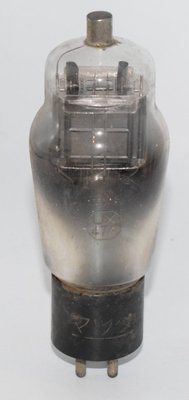
1. Introduction and History
The UX47A is an exceptionally rare vacuum tube developed for Japanese military applications during World War II. This valve was specifically designed for use in the Japanese Type 96 aircraft radio and communication systems. The tube represents an important piece of military electronics history, as it was part of Japan's wartime technological development program that aimed to create reliable communication equipment for their expanding air force.
Production of the UX47A was limited to the wartime period, primarily between 1936 (when the Type 96 aircraft was introduced) and 1945. Following Japan's defeat in WWII, production ceased entirely, making surviving specimens extremely rare and valuable to collectors and military historians. Most examples that exist today were either salvaged from downed aircraft or recovered from military surplus after the war.
The designation "UX" in its name suggests influence from American tube naming conventions, though the tube itself was manufactured to Japanese military specifications. This tube is a testament to the parallel development of vacuum tube technology across different nations during the critical wartime period.
2. Technical Specifications and Design
The UX47A is a pentode power amplifier tube designed to operate reliably under the harsh conditions of military aircraft operations. While comprehensive technical documentation is scarce due to its rarity and military origin, the following specifications are generally associated with this tube:
- Type: Pentode power amplifier
- Base: UX-type 5-pin base (similar to American UX standard)
- Heater/Filament: Likely 6.3V or 5V (specific to military aircraft electrical systems)
- Plate Voltage: Approximately 250-300V
- Screen Grid Voltage: Approximately 250V
- Plate Dissipation: Estimated 10-15W
- Transconductance: Approximately 2,000-2,500 μmhos
- Construction: Glass envelope with metal shield, designed for vibration resistance
The physical construction of the UX47A featured reinforced internal elements to withstand the vibration and acceleration forces encountered in aircraft. The tube was likely designed with special attention to filament durability and grid-to-cathode spacing stability to maintain reliable operation during flight maneuvers.
3. Applications and Usage
The UX47A was primarily employed in the radio and communication systems of the Japanese Type 96 aircraft. This aircraft, also known as the Mitsubishi G3M "Nell" bomber by Allied forces, was a prominent medium bomber used by the Imperial Japanese Navy Air Service during World War II.
Specific applications of the UX47A in these aircraft systems included:
- Radio Transmitter Output Stage: Providing sufficient power to drive aircraft radio transmitters for long-range communication
- Audio Amplification: Amplifying signals in intercom systems for crew communication
- Navigation Equipment: Possibly used in radio navigation systems
- Radar Systems: May have been incorporated into early Japanese radar detection equipment
The tube was designed to operate reliably at varying altitudes and temperatures, a critical requirement for aircraft electronics. The Type 96 aircraft operated extensively throughout the Pacific theater, meaning these tubes had to function in tropical humidity as well as at high altitudes with reduced air pressure and cooling capacity.
4. Equivalent or Substitute Types
Due to the specialized nature of this military tube, direct commercial equivalents are limited. However, several tubes with similar electrical characteristics might serve as functional substitutes in non-critical applications:
- 47 (American): The American type 47 power pentode shares some characteristics, though electrical parameters may differ
- EL34/6CA7: With appropriate circuit modifications, might substitute in audio applications
- 6F6: Another pentode with roughly similar power handling capabilities
- Japanese NEC equivalents: NEC produced several military tubes during this period that may have compatible characteristics
It's important to note that due to the specialized military design of the UX47A, any substitute would likely require significant circuit modifications and would not be historically accurate for restoration purposes. Collectors and museum restorations typically seek original specimens despite their rarity.
5. Notable Characteristics
The UX47A possesses several distinctive characteristics that set it apart from contemporary commercial tubes:
- Military-Grade Construction: Built to withstand extreme conditions including vibration, temperature variations, and high-G maneuvers
- Specialized Markings: Typically features Japanese military markings and date codes that can help identify production period
- Compact Design: Optimized for space efficiency in cramped aircraft radio compartments
- Enhanced Reliability: Designed with redundant elements or reinforced components to ensure critical communications remained functional during combat
- Historical Significance: Represents Japanese wartime electronics technology and manufacturing capabilities
Collectors value the UX47A not only for its extreme rarity but also as a tangible connection to a specific moment in military technology history. Surviving examples are often found in poor condition due to the harsh environment they operated in and the circumstances of their recovery.
For testing and collection purposes, it's worth noting that these tubes should be handled with extreme care. Their age, rarity, and potential historical significance make them valuable artifacts beyond their functional capabilities. Most surviving specimens are considered "untested" as powering them up risks damage to these irreplaceable historical items.
In conclusion, the UX47A represents a fascinating intersection of vacuum tube technology and military history. Its specialized design for the Japanese Type 96 aircraft makes it not only a rare electronic component but also an important artifact that provides insight into wartime technological development.