1. Introduction and History
The VT-136, also known by its commercial designation 1625, is a beam power tetrode vacuum tube that was developed during World War II for military applications. Introduced in the early 1940s, the VT-136 was manufactured by several companies including Tungsol, RCA, GE, and Sylvania. The tube gained prominence due to its robust design and reliability in military communication equipment.
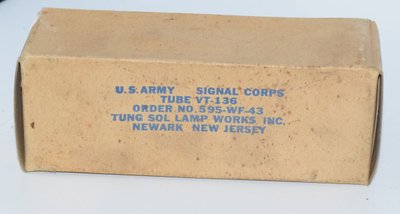
The VT-136 was essentially a 6L6 tube with a modified base and filament voltage. The military VT-136 designation refers specifically to tubes manufactured for the United States military under defense contracts. The mentioned Tungsol USA 1943 NOS (New Old Stock) variant represents tubes produced during the height of World War II, which were tested on AVO tube testers to verify their functionality.
The 1625 continued to be popular in both military and civilian applications well after World War II due to its availability as military surplus and its excellent performance characteristics.
2. Technical Specifications and Design
The VT-136/1625 features the following technical specifications:
- Tube Type: Beam power tetrode
- Base: 7-pin medium bayonet (similar to the octal base but with a different key arrangement)
- Filament/Heater: 12.6V at 0.45A (can be wired for 6.3V at 0.9A with parallel filament connection)
- Plate Dissipation: 25 watts maximum
- Maximum Plate Voltage: 600V
- Maximum Screen Voltage: 300V
- Typical Operation (Class C RF Amplifier):
- Plate Voltage: 600V
- Screen Voltage: 250V
- Grid Voltage: -45V
- Plate Current: 75mA
- Screen Current: 9mA
- Dimensions: Approximately 114mm height, 36mm diameter
The VT-136 features a distinctive design with a metal envelope and a 7-pin medium bayonet base. The tube's internal construction is similar to the 6L6, with beam-forming plates that direct the electron flow from cathode to plate, increasing efficiency and reducing screen current. The beam power design provides high power output with relatively low distortion.
A key design feature of the VT-136 is its ability to handle high plate voltages up to 600V, making it suitable for transmitter applications. The tube's construction includes a rugged plate structure capable of dissipating significant heat, contributing to its reliability in high-power applications.
3. Applications and Usage
The VT-136/1625 found widespread use in various applications:
Military Applications:
- Mobile and fixed radio transmitters
- Aircraft communication systems
- Field communications equipment
- BC-610 transmitter series
- Command set transmitters
Post-War and Amateur Radio Applications:
- RF power amplifiers in amateur radio transmitters
- Modulator stages in AM transmitters
- Push-pull audio amplifiers
- Driver stages for larger transmitting tubes
- Single-sideband (SSB) linear amplifiers
The tube became particularly popular among amateur radio operators (hams) after World War II due to its availability as surplus at low prices, combined with its excellent performance characteristics. Many ham radio operators built transmitters using pairs of 1625s in the final amplifier stage, capable of delivering 50-100 watts of RF output.
The VT-136 was also used in audio applications, where its high power capability and relatively low distortion made it suitable for high-quality audio amplifiers. In push-pull configurations, a pair of 1625s could deliver 30-40 watts of audio power with acceptable distortion figures.
4. Equivalent or Substitute Types
The VT-136/1625 has several equivalents and potential substitutes:
Direct Equivalents:
- 1625: The commercial designation for the VT-136
- VT-136A: A slightly modified military version
Related Types and Potential Substitutes:
- 6L6/5881/KT66: The 1625 is essentially a 6L6 with a different base and filament voltage. With appropriate socket and filament voltage adaptations, these can sometimes be substituted.
- 807: Another popular beam power tetrode with similar characteristics but with a 5-pin base and 6.3V filament
- 6146: Higher power capability but can be used in some applications
- 2E26: Lower power but usable in some RF applications
When considering substitutions, it's important to note that while the electrical characteristics may be similar, differences in base connections, filament requirements, and physical dimensions often necessitate circuit modifications. Direct substitution without adaptation is rarely possible.
5. Notable Characteristics
The VT-136/1625 possesses several characteristics that made it popular and enduring:
Electrical Advantages:
- High Voltage Tolerance: The ability to handle plate voltages up to 600V made it suitable for transmitter applications
- Good Power Output: Capable of delivering significant RF or audio power
- Efficiency: The beam power design provides good efficiency compared to earlier tetrode designs
- Low Drive Requirements: Requires relatively low grid driving power
- Stable Operation: Less prone to parasitic oscillations than some alternatives
Practical Advantages:
- Ruggedness: Military-grade construction provides excellent durability
- Availability: Produced in large quantities during WWII, making surplus tubes widely available
- Affordability: Post-war surplus availability made these tubes inexpensive for amateur applications
- Versatility: Suitable for both RF and audio applications
- Longevity: When operated within specifications, these tubes often provide thousands of hours of service
The 12.6V filament of the 1625 was particularly advantageous in mobile applications where 12V vehicle electrical systems were common. The tube could be operated directly from the vehicle's electrical system without requiring voltage conversion for the filament.
The Tungsol USA 1943 NOS specimens mentioned are particularly valued by collectors and vintage equipment restorers for their historical significance and typically excellent performance characteristics, as military-specification tubes were often manufactured to higher standards than their civilian counterparts.
In conclusion, the VT-136/1625 represents an important chapter in vacuum tube development, bridging military technology and post-war civilian applications. Its robust design, versatility, and widespread availability have made it a favorite among vintage radio enthusiasts and tube audio aficionados to this day.