1. Introduction and History
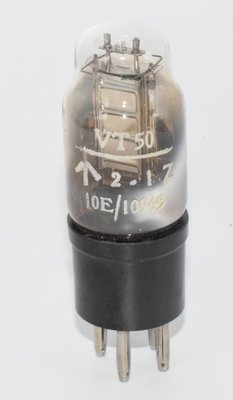
The VT50 is a medium-power triode vacuum tube that emerged during the golden age of vacuum tube development in the early-to-mid 20th century. Designed as a robust power amplification and output stage tube, the VT50 represents a significant milestone in audio electronics engineering. The designation "VT" (Vacuum Tube) followed by the number was a military and industrial standard nomenclature used primarily in the United States, particularly during World War II and the subsequent decades.
The VT50 gained prominence in professional audio equipment, radio transmitters, and high-fidelity amplifiers throughout the 1940s and 1950s. Its development coincided with the expansion of radio broadcasting and the early stages of consumer audio equipment manufacturing. The tube's robust construction and reliable performance made it a preferred choice for equipment manufacturers seeking durability and consistent output characteristics.
The HL2K designation sometimes associated with VT50 tubes indicates specific manufacturing variations or equivalent types produced by different manufacturers, particularly European valve companies. The Mullard, Telefunken, and RCA variants of this tube type became highly sought after by audio enthusiasts and professional engineers alike.
2. Technical Specifications and Design
Physical Characteristics
The VT50 is constructed as a medium-sized triode in an octal (8-pin) base configuration, typically housed in a glass envelope measuring approximately 2.75 inches in height and 1.25 inches in diameter. The octal base design provides mechanical stability and standardized socket compatibility across various equipment platforms.
Electrical Specifications
- Tube Type: Medium-power triode
- Base Type: Octal (8-pin)
- Maximum Plate Voltage: 1200-1500V (depending on operating class)
- Maximum Plate Dissipation: 25-30 watts
- Typical Plate Current: 60-100mA at nominal operating conditions
- Amplification Factor (μ): 8-12
- Plate Resistance (rp): 800-1200 ohms
- Transconductance (gm): 8-12 mA/V
- Heater Voltage: 10V AC or DC
- Heater Current: 1.25 amperes
- Typical Operating Bias: -15 to -25V grid bias
Internal Construction
The VT50 features a directly heated cathode design with a robust nickel-plated construction. The tube contains three primary elements: a heated filament/cathode, a control grid, and a plate (anode). The internal geometry is optimized for medium-power applications, with the grid structure designed to provide good linearity across the operating range.
The tube's internal construction emphasizes thermal stability through improved mica spacers and support structures. The plate is typically constructed from molybdenum or nickel-plated steel, allowing for higher dissipation ratings compared to earlier triode designs. The control grid features a relatively open mesh design, facilitating good electron flow while maintaining reasonable input impedance characteristics.
Operating Characteristics
The VT50 exhibits moderate amplification factors compared to other power triodes of its era. This characteristic makes it suitable for both voltage amplification and power output stages, though it is most commonly employed in the latter application. The tube's plate characteristics curve demonstrates good linearity in the Class AB1 and Class B operating regions, making it popular for push-pull output stage configurations.
The transconductance characteristics remain relatively stable across the operating range, contributing to the tube's reputation for consistent performance. The plate resistance value of approximately 1000 ohms necessitates careful output transformer design to achieve optimal impedance matching and frequency response.
3. Applications and Usage
Historical Applications
The VT50 found widespread use in numerous applications throughout the mid-20th century:
- Radio Transmitters: Medium-power RF output stages in AM broadcast transmitters
- Professional Audio Equipment: Mixing consoles, broadcast limiters, and audio distribution amplifiers
- High-Fidelity Amplifiers: Output stages in tube-based power amplifiers
- Industrial Equipment: Control circuits and monitoring systems requiring reliable vacuum tube amplification
- Military Applications: Communications equipment and radar systems
Modern Audio Applications
In contemporary audio circles, the VT50 remains relevant for vintage equipment restoration and enthusiast audio projects. Audiophiles and vintage equipment collectors actively seek well-preserved examples, particularly those manufactured by renowned European producers such as Mullard and Telefunken.
The tube is employed in:
- Vintage Amplifier Restoration: Replacement tubes for classic tube amplifiers from the 1940s-1960s
- Custom Audio Projects: DIY amplifier designs by tube audio enthusiasts
- Professional Studio Equipment: Restoration of vintage broadcast and recording equipment
- Collector's Equipment: Preservation and operation of historically significant audio devices
4. Sound Characteristics
Tonal Profile
The VT50 is renowned among audio professionals and enthusiasts for its warm, extended midrange presentation. The tube exhibits natural compression characteristics that contribute to a smooth, non-fatiguing sound signature. This acoustic profile has made it particularly favored in vintage broadcast and recording equipment, where sonic transparency combined with pleasant harmonic coloration was highly valued.
Harmonic Distortion Characteristics
When operated within its rated parameters, the VT50 produces primarily second and third-order harmonic distortion, which is generally perceived as musical and pleasing to the human ear. The distortion products are predominantly even-order harmonics, which add warmth and presence without introducing harsh, dissonant characteristics.
At moderate output levels, total harmonic distortion typically ranges from 1-3%, increasing gracefully as the tube approaches its maximum rated output. This gentle distortion curve contributes to the tube's valued characteristic of sounding better as it is pushed slightly into saturation, a quality highly appreciated in audio circles.
Frequency Response
The VT50 demonstrates excellent frequency response characteristics across the audio spectrum when properly matched with appropriate output transformers. The tube exhibits minimal phase shift across the midrange and upper frequencies, contributing to accurate stereo imaging and natural tonal balance. Lower frequency response depends significantly on output transformer design and coupling topology.
Dynamic Response
The tube's moderate transconductance and plate resistance result in responsive, articulate dynamic characteristics. Transient attacks are clean and well-defined, while decay characteristics remain smooth and natural. This dynamic behavior makes the VT50 particularly suitable for music reproduction where clarity and detail are valued.
Noise and Microphonics
Well-manufactured examples, particularly vintage NOS (New Old Stock) tubes from premium manufacturers, exhibit low noise floors and minimal microphonic characteristics. The robust internal construction provides good mechanical stability, reducing susceptibility to vibration-induced noise generation.
5. Equivalent or Substitute Types
Several tubes can serve as equivalents or substitutes for the VT50, depending on specific application requirements:
- HL2K: European equivalent, particularly from Mullard and Telefunken manufacturing
- 6L6: Pentode equivalent with similar power handling, though different sonic characteristics
- EL34: European power tube with comparable dissipation rating, though higher amplification factor
- 6V6: Lower-power triode alternative for reduced power applications
- 300B: Higher-quality triode alternative, though with different operating characteristics
Important Note: Direct substitution requires careful consideration of amplification factor, plate resistance, and bias requirements. Consultation with tube data manuals and qualified technicians is essential before substituting tubes in vintage equipment.
6. Notable Characteristics
Reliability and Longevity
The VT50 is celebrated for exceptional reliability and extended operational lifespan. Well-manufactured examples commonly achieve 5,000-10,000 hours of operation before showing signs of degradation. The robust construction and conservative design margins contributed to the tube's widespread adoption in professional and military applications where reliability was paramount.
Manufacturing Quality Variations
Significant quality variations exist between manufacturers and production batches. Mullard and Telefunken examples are generally considered superior to American RCA variants, with more consistent plate color, better internal geometry, and superior longevity. Telefunken examples are particularly prized for their tight construction tolerances and reliable performance characteristics.
Collector's Value
Vintage NOS VT50 tubes, particularly Telefunken and Mullard examples, command premium prices in the current collector's market. Well-preserved examples with original packaging can appreciate significantly, reflecting both their sonic desirability and historical significance. The increasing scarcity of original inventory has contributed to rising valuations.
Thermal Characteristics
The VT50 operates at moderate plate temperatures, typically reaching 650-750°C under normal operating conditions. This moderate thermal profile contributes to extended tube lifespan and allows for relatively compact amplifier designs without excessive heat management requirements.
Grid Bias Stability
The tube demonstrates excellent grid bias stability across its operating range, with minimal shift in bias point as the tube ages. This characteristic reduces the need for frequent bias adjustment in fixed-bias amplifier designs, contributing to the tube's reputation for reliable, long-term operation.
Conclusion
The VT50 represents a significant achievement in vacuum tube amplification technology, combining robust construction, reliable performance, and desirable sonic characteristics. Its continued relevance in vintage audio circles and professional restoration work testifies to its fundamental design excellence. Whether employed in original equipment or modern audio projects, the VT50 continues to deliver the warm, musical sound quality that defines the golden age of tube audio electronics.
For collectors, audio enthusiasts, and professional technicians, the VT50 remains a valued component in the ongoing appreciation and preservation of vintage audio technology. Its combination of technical competence, sonic character, and historical significance ensures its place in audio history for generations to come.