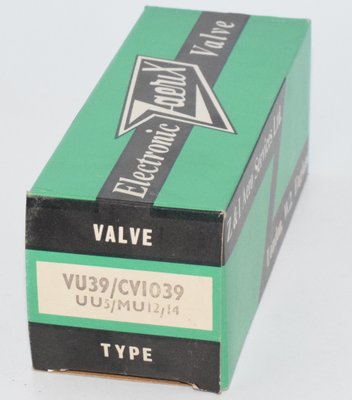
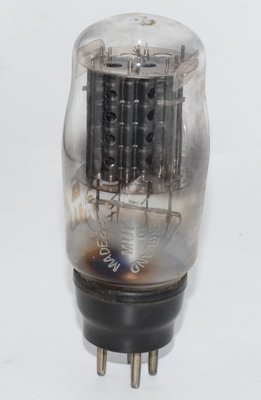
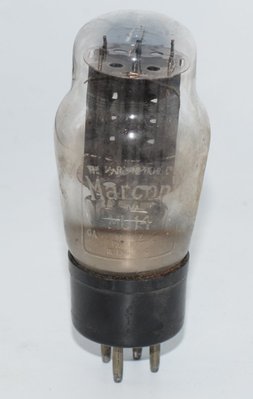
1. Introduction and History
The VU39 is a full-wave vacuum rectifier tube developed primarily for use in AC mains-powered radio receivers and amplifier power supplies. It belongs to a family of indirectly heated, full-wave rectifier valves that were widely manufactured across Europe from the 1930s through the 1950s. The VU39 was produced by several manufacturers, including Mullard, Mazda, Brimar, and various Continental European firms, and was commonly found in British and European radio equipment of the era.
The VU39 is closely associated with a number of equivalent types, including the UU5 (the older British designation), CV1039 (the British military/government designation), MU12, and MU14. These designations reflect the somewhat fragmented European valve naming conventions of the period, where different manufacturers and standards bodies assigned their own type numbers to functionally identical or very similar tubes. The Zaerix-branded NOS (New Old Stock) examples that survive today are prized by vintage radio restorers and audio enthusiasts alike.
The "U" in the European Pro-Electron/Mullard-Philips naming convention indicates a heater voltage in the range suitable for AC/DC series-string operation or specific transformer-supplied heater voltages, while the function letter denotes a rectifier. The VU39 was designed as a reliable, long-life rectifier capable of supplying the B+ (HT) voltage in medium-power radio receivers and small amplifiers.
2. Technical Specifications and Design
The VU39 is an indirectly heated, full-wave rectifier valve. Below are the key electrical and mechanical specifications. Note: Because the VU39 family encompasses several closely related types (UU5, MU12, MU14), there are minor variations in ratings depending on the specific manufacturer and date of production. The values below represent the most commonly published ratings. Users should always confirm against the specific manufacturer's datasheet for their particular tube.
Electrical Ratings
| Parameter | Value |
|---|---|
| Heater Voltage (Vf) | 4.0 V (AC) |
| Heater Current (If) | 1.0 A |
| Max AC Voltage per Plate (RMS) | 350 V RMS (typical; some sources list 250–350 V depending on variant) |
| Max Peak Inverse Voltage (PIV) | ~1000 V (estimated from AC rating; confirm against datasheet) |
| Max DC Output Current | 60–120 mA (varies by variant: MU14 is typically rated at 60 mA, MU12 at up to 120 mA) |
| Max Reservoir Capacitor | Typically 4–16 µF (depending on variant and manufacturer recommendations) |
| Internal Voltage Drop | Approximately 15–25 V per plate at rated current |
Note: As a rectifier, the VU39 does not have the usual amplifier parameters such as amplification factor (µ), transconductance (gm), or plate resistance (rp) in the conventional sense. Its key performance metrics are maximum AC input voltage, maximum DC output current, peak inverse voltage rating, and internal voltage drop.
Physical / Mechanical Details
| Parameter | Detail |
|---|---|
| Base Type | 5-pin (UX5 / International Octal in some variants — confirm for specific manufacturer). Many VU39/UU5 types use a 5-pin European base (B5) or a side-contact base depending on era. |
| Envelope Type | ST-shaped (shoulder) glass envelope, medium size; some later versions in tubular glass |
| Mounting | Vertical (base down recommended) |
| Overall Length | Approximately 110–130 mm (confirm against specific variant) |
| Maximum Diameter | Approximately 38–45 mm |
Pin-Out
The pin configuration depends on the specific base type used. For the common 5-pin (B5) European base version:
- Pin 1: Plate 1 (Anode 1)
- Pin 2: Heater (one end)
- Pin 3: Plate 2 (Anode 2)
- Pin 4: Heater (other end) / Cathode connection
- Pin 5: Cathode
Important: Pin-out assignments can vary between manufacturers and between the different equivalent types (VU39, UU5, MU12, MU14). Always verify the pin-out against the specific manufacturer's datasheet before installation. Incorrect wiring of a rectifier can cause catastrophic damage to the power supply and associated circuitry.
Construction Notes
The VU39 features an indirectly heated cathode, which provides the advantage of a dedicated cathode connection separate from the heater. This allows the heater to be referenced to ground or another potential without affecting rectifier operation — an important consideration in AC/DC receiver designs and in circuits where hum reduction is critical. The two plate structures are arranged symmetrically around the central cathode sleeve, typical of full-wave rectifier construction.
3. Applications and Usage
The VU39 and its equivalents were designed primarily for the following applications:
- Radio Receiver Power Supplies: The most common application. The VU39 served as the main HT (high tension) rectifier in countless British and European radio receivers from the 1930s through the 1950s. It converted the AC from the power transformer secondary into the DC B+ supply needed by the receiver's amplifier and detector stages.
- Small Amplifier Power Supplies: In low- to medium-power audio amplifiers (typically up to about 15–20 watts), the VU39 provided a simple, reliable rectification solution.
- Test Equipment: Various bench instruments and test equipment of the era used the VU39 or its equivalents for internal power supply rectification.
- Military/Government Equipment: The CV1039 designation indicates its approval for use in British military and government equipment, where it would have been subject to tighter quality control and testing standards.
The full-wave rectifier configuration means the VU39 requires a center-tapped transformer secondary winding. Each plate receives one half of the AC waveform, and the cathode outputs the rectified DC. A smoothing network (typically a capacitor-input or choke-input filter) follows the rectifier to reduce ripple.
4. Sound Characteristics
While rectifier tubes do not directly amplify the audio signal, experienced audiophiles and engineers have long recognized that the choice of rectifier valve has a meaningful impact on the overall sonic character of a tube amplifier. The VU39 and its family members are described in the following terms:
- Smooth, Gentle Power Delivery: Like most indirectly heated rectifiers, the VU39 provides a "soft" start-up, with the B+ voltage rising gradually as the cathode reaches operating temperature. This soft-start characteristic is kinder to filter capacitors and downstream tubes, and contributes to what listeners describe as a smooth, unhurried presentation.
- Warmth and Fullness: The relatively higher internal impedance of a valve rectifier (compared to solid-state diodes) introduces a degree of "sag" under dynamic signal demands. This sag is perceived as a subtle compression and warmth, particularly in the bass and lower midrange. The VU39's voltage drop and impedance characteristics contribute to a full-bodied, rounded tonal quality.
- Natural Dynamics: The interaction between the rectifier's impedance and the power supply's filter network creates a natural dynamic response that many listeners find more musically engaging than the "stiff" supply provided by silicon diodes. Transients are slightly softened, lending a sense of ease and naturalness to the music.
- Low Noise: When in good condition, the VU39 is generally a quiet rectifier. The indirectly heated cathode design helps minimize hum injection into the power supply, which is particularly important in sensitive audio applications.
- Vintage Character: The overall sonic signature is consistent with what is often described as a "classic British" sound — polite, refined, and slightly warm, without the aggressive edge that some directly heated rectifiers can exhibit.
It should be noted that the sonic impact of a rectifier tube is highly dependent on the overall amplifier design, the quality of the power supply filtering, and the specific operating conditions. In well-filtered designs, the differences between rectifier types may be subtle.
5. Equivalent or Substitute Types
The VU39 belongs to a family of closely related types. The following are generally considered interchangeable, but users should verify base compatibility and ratings for their specific application:
| Type | Notes |
|---|---|
| UU5 | Older British designation; generally considered directly equivalent to VU39. Verify base type matches. |
| CV1039 | British military/government designation for the same valve. Typically manufactured to tighter tolerances. |
| MU12 | Related type, often listed as equivalent. May have slightly different current ratings (up to 120 mA). Verify heater voltage (some MU12 variants use 4V heater). Confirm pin compatibility before substitution. |
| MU14 | Related type with potentially lower current rating (~60 mA). Often listed as equivalent to VU39 in lower-current applications. Confirm pin and rating compatibility. |
Caution: While these types are frequently listed together as equivalents (as in the Zaerix NOS listing), there are subtle differences in maximum ratings and, in some cases, base configurations between specific manufacturer variants. The MU12 and MU14 in particular may have different current handling capabilities. Always consult the original equipment manufacturer's documentation and the specific tube datasheet before making substitutions.
Tubes that are not direct equivalents but serve a similar function in different base configurations include the EZ80, EZ81, GZ34, and 5Y3GT. These are not pin-compatible with the VU39 and cannot be substituted without circuit modification.
6. Notable Characteristics
- Indirectly Heated Cathode: Unlike many rectifiers of its era (such as the 5Y3 or 5U4), the VU39 uses an indirectly heated cathode. This provides better hum rejection and allows more flexible heater wiring configurations, but results in a slightly longer warm-up time before the B+ voltage reaches its full value.
- Robust Construction: The VU39 was designed for continuous domestic and commercial use and is generally a long-lived, reliable tube. NOS examples from quality manufacturers like Mullard, Brimar, and Zaerix are often still testing at or near new specifications decades after manufacture.
- Soft-Start Behavior: The gradual B+ rise during warm-up acts as a natural inrush limiter, protecting electrolytic capacitors and extending the life of downstream tubes. This is a significant advantage in vintage equipment restoration where original capacitors may be aged.
- Sensitivity to Overload: Like all valve rectifiers, the VU39 can be damaged by excessive current draw or by excessively large reservoir capacitors that cause high peak charging currents. Adherence to the manufacturer's maximum capacitor and current ratings is essential.
- Collector Appeal: NOS examples, particularly those with military CV1039 markings or from well-known manufacturers, are sought after by vintage radio collectors and audio enthusiasts. The Zaerix-branded NOS tubes represent a good-quality, often more affordable alternative to premium-branded examples.
7. Usage in the Audio Community
The VU39 and its equivalents occupy a specific niche in the audio community:
Vintage Radio Restoration
The primary demand for VU39 tubes comes from the vintage radio restoration community. Many classic British and European radio receivers from the 1930s–1950s specified the VU39, UU5, or MU14 as the rectifier. Restorers seeking to maintain originality and authenticity require these exact types, and NOS examples are the preferred choice over used pulls.
DIY and Custom Amplifier Builds
Some adventurous DIY audio builders incorporate the VU39 into custom amplifier power supplies, particularly when designing amplifiers with a deliberately vintage British character. The 4V heater requirement means a dedicated heater winding is needed, which is straightforward with a custom power transformer. The moderate current capability makes the VU39 suitable for single-ended and small push-pull amplifier designs.
Comparison with Popular Audio Rectifiers
In the broader audio community, the VU39 is less well-known than popular rectifier types like the GZ34/5AR4, 5U4, or 5Y3, which dominate American-influenced amplifier designs. However, those who have used the VU39 often comment favorably on its smooth, quiet operation and its contribution to a refined, warm sonic character. It represents an interesting alternative for builders looking to explore European valve types beyond the usual American-derived designs.
Availability and Pricing
As a less mainstream type, the VU39 is not as widely available as common octal rectifiers. NOS examples from manufacturers like Zaerix, Mullard, Brimar, and others can still be found from specialist vintage tube dealers. Pricing is generally moderate — less expensive than premium GZ34 NOS tubes, but availability can be inconsistent. The listing of VU39/UU5/CV1039/MU12/MU14 Zaerix NOS tubes reflects the typical market offering, where sellers group the equivalent types together to help buyers identify the correct replacement for their equipment.
Practical Considerations for Audio Use
When using the VU39 in audio applications, the following practical points should be considered:
- Ensure the power transformer has an appropriate 4V heater winding rated for at least 1A.
- Verify that the transformer's HT secondary voltage does not exceed the VU39's maximum AC plate voltage rating.
- Keep the reservoir capacitor within the manufacturer's recommended maximum to prevent excessive peak current through the rectifier.
- Allow adequate ventilation around the tube, as rectifiers can run warm under load.
- Test NOS tubes before installation, as decades of storage can occasionally result in degraded emission or inter-electrode leakage.