1. Introduction and History
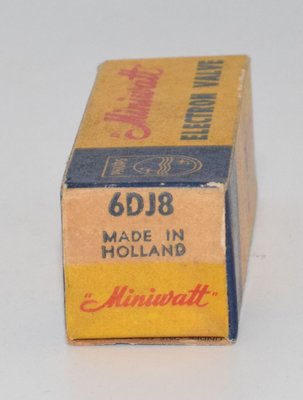
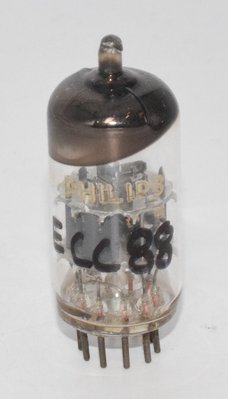
The 6922 is a premium-grade medium-mu twin triode vacuum tube developed in the late 1950s as a ruggedized, long-life version of the popular 6DJ8/ECC88. Designated under the European Pro-Electron system as the E88CC, the 6922 was originally designed for use in professional and military-grade instrumentation, telecommunications equipment, and high-reliability applications where tight parameter matching and extended service life were paramount.
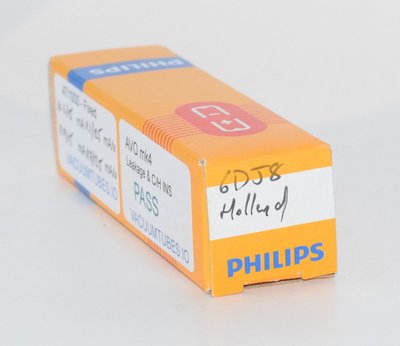
The tube was manufactured by virtually every major tube producer of the era, including RCA (Harrison, N.J.), Amperex, Mullard, Siemens, Telefunken, Philips, and Sylvania. The RCA datasheet dated 5-62 (May 1962) provides the definitive American specification for this type. The European E88CC designation indicates a special-quality ("CC" suffix) version intended for professional equipment, with tighter manufacturing tolerances and more rigorous testing than the standard ECC88/6DJ8.
Originally conceived for wideband amplifier service in test instruments, radar IF strips, and cascode RF amplifiers, the 6922 found a second life beginning in the 1980s and 1990s as one of the most sought-after small-signal tubes in high-end audio. Its combination of high transconductance, low noise, and excellent linearity made it a natural choice for audiophile preamplifiers, DAC output stages, and headphone amplifiers. Today, the 6922/E88CC remains one of the most popular and widely discussed tubes in the audio community.
2. Technical Specifications and Design
General Description
The 6922 is a medium-mu twin triode in a 9-pin miniature (Noval) envelope. It contains two independent triode sections sharing a common heater and an internal shield. The tube uses coated unipotential cathodes and can be operated in any position.
Heater Ratings (Design-Center Values)
| Heater Voltage (AC or DC) | 6.3 ± 0.6 V |
| Heater Current (at 6.3V) | 0.300 A |
| Peak Heater-Cathode Voltage (heater negative w.r.t. cathode) | 60 V max. |
| Peak Heater-Cathode Voltage (heater positive w.r.t. cathode) | 120 V max. |
Direct Interelectrode Capacitances (without external shield)
| Parameter | Unit No. 1 | Unit No. 2 |
|---|---|---|
| Grid to Plate (Cga) | 1.4 µµF | 1.4 µµF |
| Grid to Cathode, Internal Shield & Heater (Cgk) | 3.1 µµF | 3.1 µµF |
| Plate to Cathode, Internal Shield & Heater (Cak) | 1.75 µµF | 1.65 µµF |
| Heater to Cathode | 2.6 µµF | 2.7 µµF |
Note: TDSL reference data lists Cgk = 3.3 pF, Cak = 0.18 pF, and Cga = 1.4 pF. The slight differences between these values and the RCA datasheet figures may reflect measurement conditions (with/without external shield) or rounding conventions. The RCA datasheet values above are measured without external shield.
Characteristics — Class A1 Amplifier (Each Unit)
| Parameter | Condition 1 (Recommended) | Condition 2 |
|---|---|---|
| Plate Supply Voltage | 100 V | 90 V |
| Grid Supply Voltage | 9 V | 0 V |
| Cathode Resistor | 680 Ω | 120 Ω |
| Amplification Factor (µ) | 33 | — |
| Transconductance (gm) | 12,500 µmhos | 11,500 µmhos |
| Plate Current | 15 mA | 12 mA |
The RCA datasheet recommends operation under the conditions listed in the left-hand column (Condition 1) because of the small spread in characteristics achievable at those operating points. From the amplification factor (µ = 33) and transconductance (gm = 12,500 µmhos), the plate resistance (rp) can be calculated as:
rp = µ / gm = 33 / 0.0125 = 2,640 Ω
Maximum Ratings — Class A1 Amplifier (Design-Center Values, Each Unit)
| Parameter | Rating |
|---|---|
| Plate Voltage (with plate dissipation ≥ 0.8W) | 220 V max. |
| Plate Voltage (with plate dissipation < 0.8W) | 250 V max. |
| Plate Voltage (with plate current = 0) | 400 V max. |
| Plate Voltage (with cathode current = 0) | 550 V max. |
| Grid Voltage (negative-bias value) | 100 V max. |
| Grid Voltage (peak-negative value)* | 200 V max. |
| Cathode Current (peak)* | 100 mA max. |
| Cathode Current (average) | 20 mA max. |
| Grid Input | 0.03 W max. |
| Plate Dissipation (either plate) | 1.5 W max. |
| Plate Dissipation (both plates, both units operating) | 2.0 W max. |
| Bulb Temperature (hottest point on bulb surface) | 170°C max. |
* Pulse duration (microseconds) = 200 max., duty factor = 0.10 max.
Maximum Circuit Values
| Grid-Circuit Resistance (fixed-bias operation) | Permitted only when plate current < 5 mA |
| Grid-Circuit Resistance (cathode-bias operation) | 1 MΩ max. |
Special Ratings & Performance Data
| Shock Rating — Impact Acceleration | 500 g max. |
| Fatigue Rating — Vibrational Acceleration | 2.5 g max. (32 hours at 50 cps in each of 3 directions) |
The shock test is performed using a Navy Type, High-Impact (Flyweight) Shock Machine with 5 blows at a hammer angle of 30°. Tubes are held rigid in four different positions. These rugged specifications reflect the 6922's military/professional heritage and distinguish it from the standard 6DJ8/ECC88.
Physical and Mechanical Details
| Base | Small-Button Noval 9-Pin (JEDEC No. E9-1) / B9A |
| Bulb / Envelope | T6-1/2 |
| Cathode Type | Coated Unipotential |
| Operating Position | Any |
| Maximum Overall Length | 2-3/16" |
| Maximum Seated Length | 1-15/16" |
| Length, Base Seat to Bulb Top (excl. tip) | 1-9/16" ± 3/32" |
| Diameter | 0.750" to 0.875" |
| Basing Designation (Bottom View) | 9AJ |
Pin Configuration (Bottom View)
| Pin | Function |
|---|---|
| Pin 1 | Plate of Unit No. 2 |
| Pin 2 | Grid of Unit No. 2 |
| Pin 3 | Cathode of Unit No. 2 |
| Pin 4 | Heater |
| Pin 5 | Heater |
| Pin 6 | Plate of Unit No. 1 |
| Pin 7 | Grid of Unit No. 1 |
| Pin 8 | Cathode of Unit No. 1 |
| Pin 9 | Internal Shield |
3. Applications and Usage
The 6922/E88CC was designed for demanding professional applications requiring high reliability, low noise, and tight section-to-section matching. Its original intended applications included:
- Wideband amplifiers — The high transconductance of 12,500 µmhos combined with relatively low interelectrode capacitances made the 6922 excellent for broadband video and instrumentation amplifiers.
- Cascode RF and IF amplifiers — The tube's low Miller capacitance and high gm made it ideal for cascode configurations in radar IF strips and communications receivers.
- Test and measurement equipment — Hewlett-Packard, Tektronix, and other instrument manufacturers used the 6922 extensively in oscilloscopes, voltmeters, and signal generators where drift and noise had to be minimized.
- Telecommunications — Carrier telephone systems and repeater amplifiers relied on the E88CC's long life and stable characteristics.
- Military electronics — The 500g shock rating and 2.5g vibrational fatigue rating qualified the 6922 for shipboard and airborne equipment.
- Computer circuits — Early digital computers used the 6922 in switching and gating circuits, taking advantage of its sharp cutoff characteristics and fast recovery time.
In modern times, the 6922 has become predominantly an audio tube, used in high-end preamplifiers, phono stages, DAC output stages, headphone amplifiers, and occasionally as a driver tube in power amplifier circuits.
4. Sound Characteristics
The 6922/E88CC is widely regarded as one of the finest small-signal tubes for audio applications, and its sonic character has been extensively discussed and debated in the audiophile community. While sound perception is inherently subjective and heavily dependent on circuit topology, operating point, and associated components, certain consistent themes emerge across decades of listener reports:
General Sonic Signature
The 6922 is typically described as having a refined, detailed, and slightly warm tonal character. Compared to the 12AX7/ECC83 family, the 6922 offers notably lower output impedance (owing to its low rp of approximately 2,640 Ω) and higher transconductance, which translates into a more authoritative, controlled sound with superior transient response and better bass definition.
Tonal Qualities by Manufacturer
One of the most fascinating aspects of the 6922 is how dramatically its sonic character varies by manufacturer and production era:
- Siemens E88CC — Widely considered among the finest, Siemens tubes are praised for exceptional clarity, transparency, and a slightly analytical presentation. They offer outstanding detail retrieval with a neutral-to-slightly-cool tonal balance, excellent imaging, and a deep, well-defined soundstage. The grey-shield versions are particularly coveted.
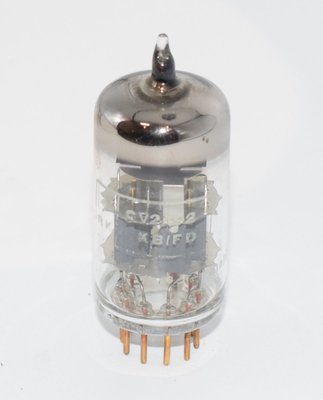
- Mullard E88CC (Mitcham factory) — Mullard tubes from the Mitcham, UK factory are prized for their rich, warm midrange with a lush, slightly romantic character. They offer excellent tonal density and body, with smooth treble and satisfying bass weight. The gold-pin versions from the early 1960s are especially sought after.
- Amperex (Heerlen, Holland) — Often considered the gold standard for the type, Amperex E88CC/6922 tubes (particularly the "orange globe" and "Bugle Boy" labeled variants) are celebrated for their magical midrange, three-dimensional soundstaging, and a beautifully balanced tonal character that is neither too warm nor too analytical. They are frequently described as "musical" above all else.
- Telefunken E88CC — Characterized by exceptional resolution and speed, Telefunken tubes offer a fast, dynamic, and highly detailed sound with outstanding high-frequency extension. They tend toward a leaner, more precise presentation than Mullard or Amperex.
- Sylvania 6922 — American-made Sylvania tubes are generally described as offering good all-around performance with a slightly forward, lively character. They provide solid dynamics and good detail, though they are typically considered a step below the best European examples in terms of refinement.
- RCA 6922 — RCA tubes tend toward a warm, smooth presentation with good bass and a forgiving treble. They are pleasant and musical, if not the last word in resolution.
Key Sonic Attributes
- Noise floor: The 6922's special-quality construction results in exceptionally low microphonics and hum, making it ideal for high-gain phono stages and sensitive line-level circuits.
- Dynamics: The high transconductance (12,500 µmhos) contributes to excellent micro- and macro-dynamic performance.
- Soundstage: The 6922 is consistently praised for its ability to present a wide, deep, and three-dimensional soundstage with precise image placement.
- Frequency response: The tube's wideband heritage translates into extended, airy treble and well-controlled bass response in audio circuits.
5. Equivalent or Substitute Types
Close / Identical Substitutes (Drop-in Replacements)
The following types are genuinely interchangeable with the 6922 with identical pinout, heater requirements, and ratings:
- E88CC — The European Pro-Electron designation for the same tube. Identical in all respects.
- 6922WA — A further ruggedized military version with even tighter specifications.
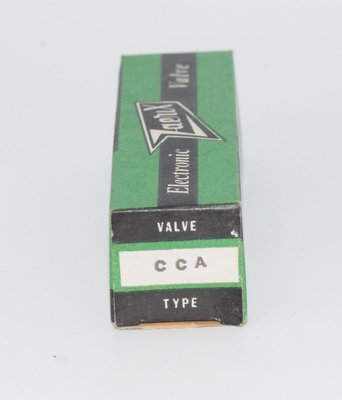
- CCA — Amperex premium-grade designation, essentially a hand-selected E88CC.
- CV2492 — British military (CV) designation for the E88CC.
- CV2493 — Another British CV designation for this type.
- CV8065 — British CV equivalent.
- CV10320 — British CV equivalent.
- E88CC-01 — Special-quality selected version.
- ECC868 — Philips designation, identical to E88CC.
Different Rating Substitutes (NOT Direct Drop-in)
The following types share the same pinout and can physically be plugged in, but have different maximum ratings and should only be substituted with caution and understanding of the circuit requirements:
- 6DJ8 / ECC88 — The standard-grade commercial version. Lower maximum plate voltage ratings and less stringent manufacturing tolerances than the 6922. The 6DJ8 can generally be used in place of a 6922 if the circuit operates within 6DJ8 ratings, but the 6922 should not be assumed to work identically in all 6DJ8 circuits without verification. The 6DJ8 has a lower plate dissipation rating and is not built to the same shock and vibration standards.
- 6N23P (6Н23П) — The Soviet equivalent. While broadly similar in characteristics, manufacturing tolerances and quality vary significantly. Some production runs are excellent; others are inconsistent. Not a guaranteed drop-in replacement in critical circuits.
- CV5358 — A British CV type with different ratings from the 6922.
Important Note: The 6922/E88CC is not interchangeable with the 12AU7/ECC82, 12AT7/ECC81, or 12AX7/ECC83 families. These have different heater voltages (12.6V vs. 6.3V), different pinouts, and completely different operating characteristics. Substituting across these families will result in damage to the tube or circuit.
6. Notable Characteristics
Military-Grade Ruggedness
The 6922 was designed to withstand impact acceleration of 500g and sustained vibrational acceleration of 2.5g at 50 cycles per second for 32 hours in each of three directions. This level of mechanical robustness is far beyond what standard commercial tubes are required to endure, and it contributes to the 6922's reputation for long life and reliability.
Tight Section Matching
The "CC" suffix in the E88CC designation indicates that both triode sections are manufactured and tested to match closely. The RCA datasheet specifically recommends the operating conditions in the left-hand column of the characteristics table "because of the small spread in characteristics." This inherent matching makes the 6922 ideal for balanced/differential circuits and push-pull driver stages.
Internal Shield
Pin 9 provides access to an internal shield between the two triode sections. This shield reduces crosstalk between the sections and lowers the effective interelectrode capacitances. In audio applications, connecting the internal shield to ground (or to the cathode circuit) can reduce hum and improve channel separation.
High Transconductance
With a transconductance of 12,500 µmhos (12.5 mA/V), the 6922 offers significantly higher gain-bandwidth product than the 12AX7 (typically 1,600 µmhos) or 12AU7 (typically 2,200 µmhos). This high gm combined with a moderate amplification factor of 33 and low plate resistance of approximately 2,640 Ω gives the 6922 excellent drive capability and low output impedance — highly desirable characteristics in audio line stages.
Low Noise Construction
The coated unipotential cathode design, combined with the tight mechanical construction required for shock and vibration resistance, results in inherently low microphonic noise. This makes the 6922 particularly well-suited for phono preamplifiers and other high-gain, low-level signal applications.
Heater Current Consideration
At 0.300A heater current (for both sections combined), the 6922 draws roughly twice the heater current of a 12AX7 (0.15A at 12.6V). Power supply design must account for this, particularly in equipment using multiple 6922 tubes.
7. Usage in the Audio Community
Prevalence in High-End Audio
The 6922/E88CC has become one of the most widely used small-signal tubes in high-end audio equipment. Major manufacturers who have designed equipment around this tube type include Audio Research, Conrad-Johnson, BAT (Balanced Audio Technology), Sonic Frontiers, Aesthetix, Manley, Cary Audio, Rogue Audio, and many others. It is particularly prevalent in:
- Line-stage preamplifiers — The 6922's low output impedance and high linearity make it ideal for driving long interconnect cables and low-impedance loads.
- Phono preamplifiers — Low noise and high gain make the 6922 an excellent choice for RIAA phono stages, particularly for moving-coil cartridge amplification.
- DAC output stages — Many tube DACs use the 6922 as an analog output buffer, adding harmonic richness to the digital signal path.
- Headphone amplifiers — The 6922's ability to drive relatively low impedances makes it suitable for headphone output stages.
- Buffer stages — The low plate resistance makes the 6922 an effective cathode follower or buffer stage.
The NOS Market
The 6922/E88CC has spawned one of the most active and passionate segments of the NOS (New Old Stock) tube market. Vintage tubes from premium manufacturers command extraordinary prices:
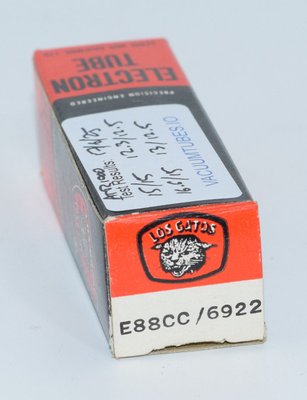
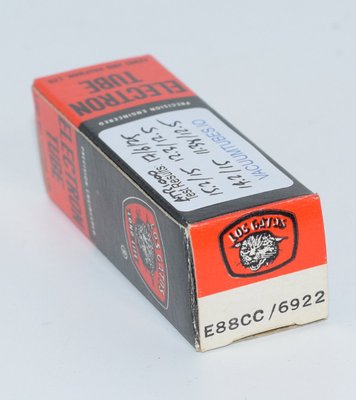
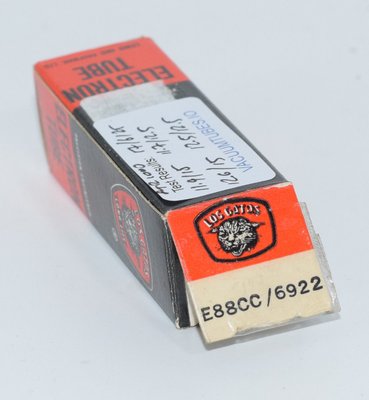
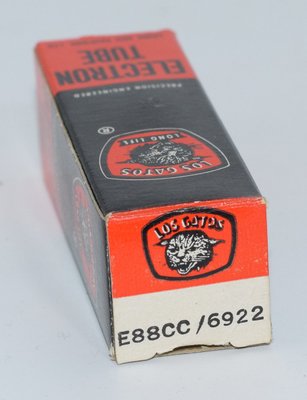
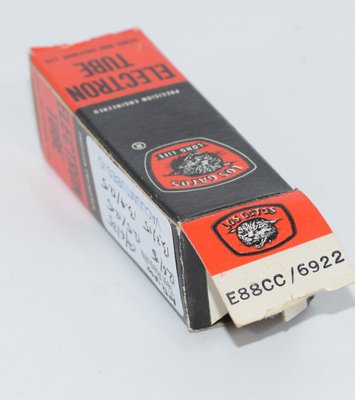
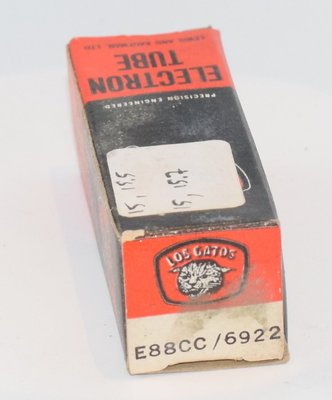
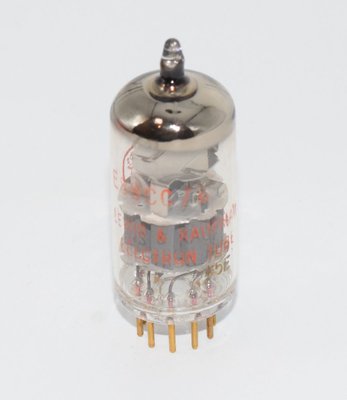
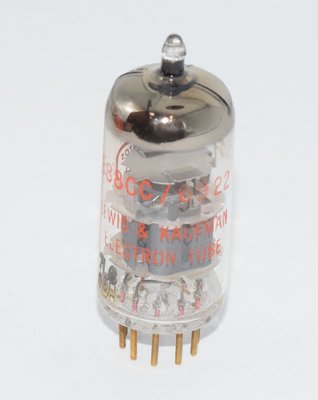
- Mullard E88CC from the Mitcham UK factory (circa 1961) — Gold-pin versions are highly prized, often found relabeled by distributors such as Los Gatos. These are among the most sought-after variants for their rich, musical character.
- Siemens E88CC with gold pins — Frequently encountered with '20' stamped on the base, these are revered for their clarity and detail. Examples relabeled by Los Gatos and other distributors are commonly found in the market.
- Sylvania 6922 (USA manufacture) — Gold-pin NOS examples, sometimes relabeled by Los Gatos, offer solid American-made quality at somewhat more accessible prices than the top European brands.
- Amperex (Holland) — "Orange globe" logo and "Bugle Boy" branded tubes from the Heerlen factory are legendary and command premium prices.
- Telefunken E88CC — Identified by the distinctive diamond-shaped mark on the bottom of the tube, these are among the rarest and most expensive variants.
The relabeling practice — where distributors like Los Gatos purchased tubes from major manufacturers and sold them under their own branding — is common with the 6922 and can make identification challenging. Experienced collectors learn to identify the actual manufacturer by examining internal construction details, getter shape, plate structure, and factory codes etched into the glass.
Current Production
Several manufacturers continue to produce the 6922/E88CC today, including:
- JJ Electronic (Slovakia) — Produces the E88CC and ECC88, offering good value and consistent quality.
- Electro-Harmonix / New Sensor (Russia) — Produces the 6922EH, a widely available and affordable current-production option.
- Genalex Gold Lion (reissue, manufactured by New Sensor) — A premium current-production option that attempts to recapture the character of vintage British tubes.
While current-production tubes have improved significantly in recent years, many audiophiles still prefer NOS examples from the golden age of tube manufacturing (1950s–1970s) for their perceived superior sonic qualities, tighter construction tolerances, and the use of materials and manufacturing techniques that are no longer economically viable.
Tube Rolling
"Tube rolling" — the practice of swapping different brands and vintages of compatible tubes to alter the sound of a component — is perhaps more popular with the 6922/E88CC than with any other tube type. The wide variety of manufacturers, the significant sonic differences between brands, and the tube's prevalence in high-end equipment have created a vibrant culture of experimentation. Audiophiles often maintain collections of different 6922 variants and swap them to fine-tune the tonal balance of their systems to match personal preferences, different recordings, or changes in associated equipment.
The 6922/E88CC remains a cornerstone of the vacuum tube audio world — a tube whose engineering excellence, sonic versatility, and rich manufacturing heritage continue to captivate engineers and music lovers alike more than six decades after its introduction.