1. Introduction and History
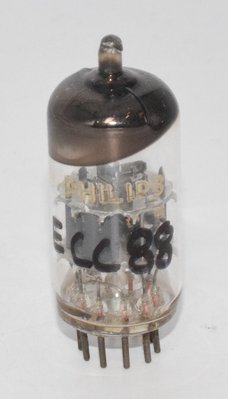
The 6DJ8, known in European nomenclature as the ECC88, is a medium-mu dual triode vacuum tube that was developed by Philips in the mid-1950s. It was originally designed for use as a low-noise, high-frequency amplifier in television tuner (VHF front-end) circuits, where its combination of high transconductance, low noise, and excellent performance at frequencies up to several hundred megahertz made it an ideal choice. The tube was introduced around 1956–1958 and quickly became one of the most widely produced and utilized small-signal dual triodes in the world.
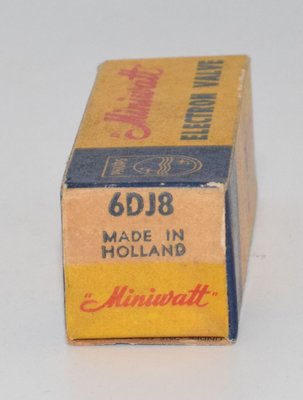
The Philips development team in Eindhoven and the manufacturing facility in Heerlen, Netherlands, were central to the tube's creation and early production. Under the Philips Miniwatt brand, the ECC88 was manufactured in enormous quantities throughout the late 1950s and 1960s. Other major manufacturers soon produced their own versions, including Amperex (Philips' American subsidiary), Mullard (Philips' British subsidiary), Siemens, Telefunken, Valvo, and numerous others across Europe and the United States. In the US, the tube was registered under the RETMA designation 6DJ8.
While designed for RF and IF applications in television receivers, the 6DJ8/ECC88 found a second life beginning in the 1980s and accelerating through the 1990s and 2000s as a prized audio tube. High-end audio designers discovered that its electrical characteristics — particularly its high transconductance and low internal noise — made it exceptionally well-suited for use in preamplifier and headphone amplifier circuits. Today, the 6DJ8/ECC88 is one of the most sought-after tubes in the audiophile community, with vintage examples from Philips Heerlen, Amperex, Siemens, and Telefunken commanding premium prices.
2. Technical Specifications and Design
General Description
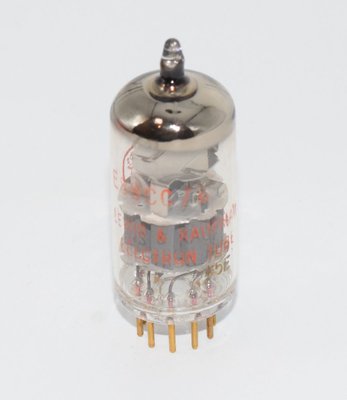
The 6DJ8/ECC88 is a double triode (two independent triode sections sharing a common envelope) designed for low-noise, high-frequency amplification. Each triode section features a frame-grid construction, which was a significant advancement over the older wound-grid designs, enabling tighter manufacturing tolerances, higher transconductance, and better high-frequency performance.
Heater / Filament Ratings
| Parameter | Value |
|---|---|
| Heater Voltage (Vf) | 6.3 V |
| Heater Current (If) | 0.365 A (for both sections combined) |
| Heater Configuration | Parallel (series operation at 12.6 V is not standard for the 6DJ8; see 12DJ8/ECC189 for the 12.6 V equivalent) |
Maximum Ratings (Per Section)
| Parameter | Value |
|---|---|
| Maximum Plate Voltage (Va max) | 130 V |
| Maximum Plate Dissipation (Wa max) | 1.8 W |
| Maximum Cathode Current (Ik max) | 20 mA |
| Maximum Grid Voltage (Vg1, negative) | −50 V (with respect to cathode) |
| Maximum Heater-Cathode Voltage (Vhk) | ±100 V |
Typical Operating Conditions and Characteristics (Per Section)
| Parameter | Condition 1 | Condition 2 |
|---|---|---|
| Plate Voltage (Va) | 90 V | 100 V |
| Grid Voltage (Vg1) | −1.2 V | −1.3 V |
| Plate Current (Ia) | 15 mA | 15 mA |
| Amplification Factor (μ) | 33 | 33 |
| Transconductance (gm) | 12.5 mA/V (12,500 µmhos) | 12.5 mA/V |
| Plate Resistance (rp) | 2.6 kΩ | 2.6 kΩ |
Note: The above values are taken from the Philips/Amperex datasheet for the ECC88/6DJ8. Some datasheets list the amplification factor as approximately 33, while others round to 33. The transconductance of 12.5 mA/V is consistently reported across major datasheets. These values are for the typical operating point of Va = 90 V, Ia = 15 mA.
Key Electrical Characteristics Summary
- Amplification Factor (μ): ~33
- Transconductance (gm): 12.5 mA/V (12,500 µS)
- Plate Resistance (rp): ~2.6 kΩ
- Grid Bias Range: Typically −1.0 V to −2.0 V for normal operating points; maximum negative grid voltage is −50 V
Physical Construction
| Parameter | Value |
|---|---|
| Base Type | Noval (B9A) — 9-pin miniature |
| Envelope Type | Miniature glass (T-6½ / 19mm diameter approximately) |
| Mounting Position | Any |
| Overall Length | Approximately 55 mm (excluding pins) |
| Maximum Diameter | Approximately 19.5 mm |
| Weight | Approximately 10–12 g |
Pin-Out (Noval B9A Base, Bottom View)
        Pin 1 — Anode (Plate) of Triode 1 (a1)
        Pin 2 — Grid of Triode 1 (g1)
        Pin 3 — Cathode of Triode 1 (k1)
        Pin 4 — Heater (one end) (f)
        Pin 5 — Heater (other end) (f)
        Pin 6 — Anode (Plate) of Triode 2 (a2)
        Pin 7 — Grid of Triode 2 (g2)
        Pin 8 — Cathode of Triode 2 (k2)
        Pin 9 — Internal shield / heater center-tap (where applicable)
Note: Pin 9 is connected to an internal shield in many versions. In some circuit applications, it is connected to ground or left unconnected. Always consult the specific manufacturer's datasheet for your particular production variant.
3. Applications and Usage
Original Intended Applications
- Television VHF Tuners: The 6DJ8/ECC88 was specifically designed for cascode RF amplifier stages in VHF television front-ends, where its high transconductance and low noise figure at frequencies up to 250 MHz and beyond were critical.
- FM Tuner Front-Ends: Similarly used in high-quality FM radio receivers for RF amplification and mixer stages.
- Wideband Amplifiers: The tube's excellent high-frequency characteristics made it suitable for instrumentation amplifiers and oscilloscope vertical amplifiers.
- Test Equipment: Hewlett-Packard, Tektronix, and other test equipment manufacturers used the 6DJ8 extensively in their instruments.
Audio Applications
- Preamplifiers: Voltage amplification stages in high-end preamplifiers, where the high gm allows for excellent gain with low noise.
- Headphone Amplifiers: The relatively low plate resistance and high transconductance make the 6DJ8 capable of driving headphones with authority, either directly or through output stages.
- DAC Output Stages: Used as an analog output buffer/amplifier following digital-to-analog converters in high-end CD players and DACs.
- Phono Stages: The low noise characteristics make it suitable for RIAA phono preamplifier circuits, particularly for moving-magnet cartridges.
- Line Stages: General-purpose line-level amplification in high-fidelity audio systems.
4. Sound Characteristics
The 6DJ8/ECC88 family has developed a strong reputation in the audiophile community for a distinctive sonic signature that varies somewhat by manufacturer and vintage, but shares certain common traits:
General Sonic Character
The 6DJ8/ECC88 is widely regarded as a detailed, transparent, and dynamic-sounding tube. Compared to the more commonly encountered 12AX7/ECC83 or 12AU7/ECC82, the 6DJ8 tends to offer:
- Exceptional Detail and Resolution: The high transconductance translates into a sense of immediacy and micro-detail retrieval that many listeners find captivating. Fine textures in recordings — the shimmer of cymbals, the breath of a vocalist, the rosin on a bow — are rendered with remarkable clarity.
- Extended and Airy Treble: Owing to its RF heritage, the 6DJ8 typically exhibits excellent high-frequency extension. The treble is often described as open, airy, and sparkling without being harsh — though poorly designed circuits or worn tubes can tip into brightness.
- Fast Transient Response: The tube's low plate resistance and high gm contribute to a sense of speed and dynamic agility. Percussive attacks are rendered with snap and precision.
- Tight, Controlled Bass: While not as warm or full in the low frequencies as some higher-mu triodes like the 12AX7, the 6DJ8 delivers bass that is taut, well-defined, and articulate.
- Wide and Precise Soundstage: Well-made examples, particularly vintage Philips/Amperex and Siemens production, are praised for creating a spacious, three-dimensional soundstage with excellent imaging.
Manufacturer-Specific Sonic Variations
- Philips Heerlen / Amperex (Holland): Often considered the gold standard. Described as having a rich, full-bodied midrange with excellent dimensionality, combined with the family's characteristic detail and transparency. The famous "Bugle Boy" branded Amperex tubes from Heerlen are among the most prized. The 1962 Philips Miniwatt Heerlen production is particularly sought after for its combination of warmth and resolution.
- Siemens (Germany): Known for an exceptionally clean, precise, and neutral presentation. Slightly leaner in the midrange compared to Philips, but with outstanding high-frequency extension and transient speed. Favored by listeners who prioritize accuracy.
- Telefunken (Germany): Similar to Siemens but often described as having a touch more warmth and body in the midrange, with a slightly smoother treble. Extremely rare and expensive.
- Mullard (UK): Tends toward a warmer, more romantic presentation compared to the Dutch and German tubes, with a lush midrange and slightly softer treble. Less common in the 6DJ8/ECC88 type than in 12AX7/ECC83.
Comparison with Related Tube Types
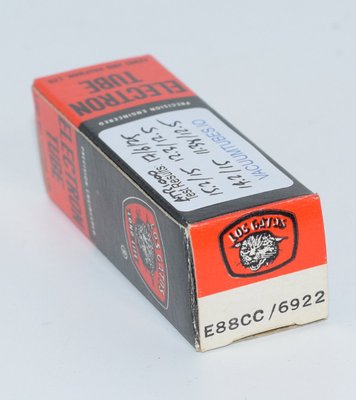
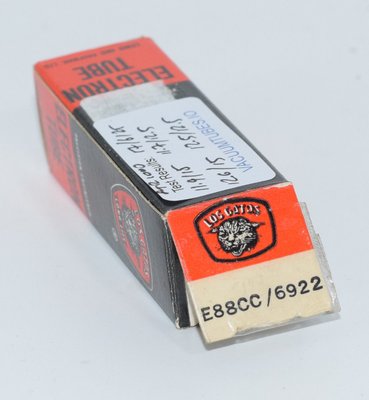
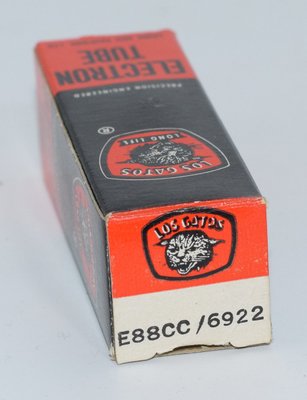
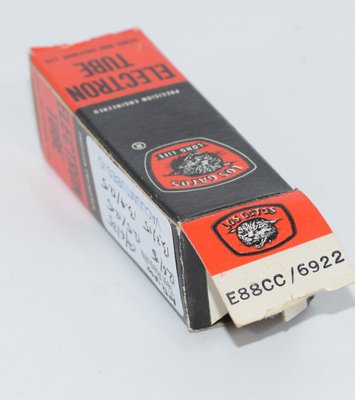
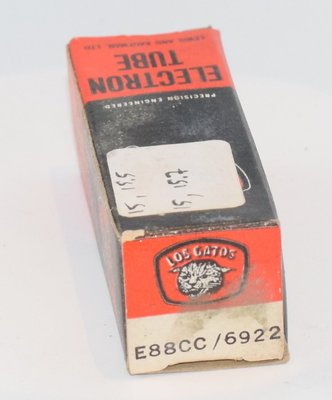
Compared to the 12AX7/ECC83, the 6DJ8 sounds more transparent, faster, and more detailed, but with less midrange warmth and body. Compared to the 6922/E88CC (its premium variant), the standard 6DJ8/ECC88 can sound slightly less refined and controlled, though the differences are often subtle and circuit-dependent.
5. Equivalent or Substitute Types
The 6DJ8/ECC88 belongs to a family of closely related types. However, substitution requires careful attention to differences in maximum ratings:
| Type | Equivalence | Notes |
|---|---|---|
| ECC88 | Direct equivalent | European designation for the same tube. Fully interchangeable with 6DJ8. |
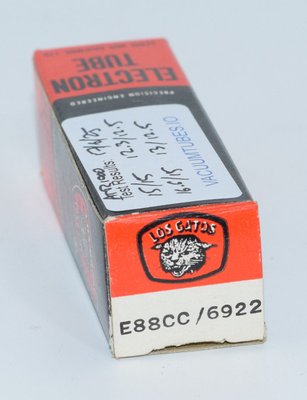
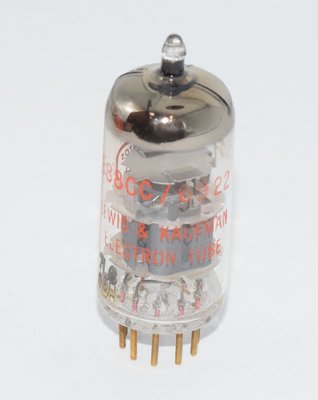
| 6922 / E88CC | Premium substitute — can replace 6DJ8 | The E88CC/6922 is the Special Quality (SQ) version of the ECC88. It has tighter manufacturing tolerances, longer rated life (10,000 hours vs. ~5,000 hours for ECC88), and higher maximum plate voltage (220 V vs. 130 V). A 6922 can always replace a 6DJ8, but a 6DJ8 should not be used in circuits designed specifically for the 6922's higher voltage ratings. |
| E188CC / 7308 | Premium substitute — can replace 6DJ8 | The ultra-premium "Special Quality, Long Life" version. Even tighter tolerances and longer rated life than the 6922/E88CC. Higher maximum plate voltage (220 V). Can replace 6DJ8 in any circuit. The 7308 is the US designation. |
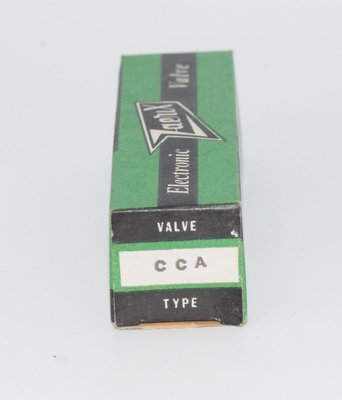
| CCa | Premium substitute — can replace 6DJ8 | Siemens' proprietary premium version, equivalent to the E88CC/6922 in ratings but manufactured to Siemens' own exacting standards. Extremely sought-after and expensive. Can replace 6DJ8. |
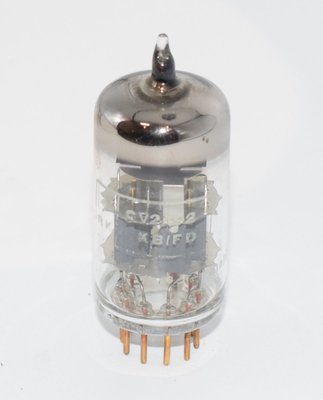
| CV2492 | Direct equivalent | British military (CV) designation for the ECC88. Fully interchangeable. |
| CV2493 | Premium substitute | British military designation for the E88CC. Can replace 6DJ8. |
| 6ES8 / ECC189 | Not directly interchangeable | Similar construction but different operating characteristics. While pin-compatible, the ECC189 has different bias requirements and is not a recommended substitute without circuit modification. |
| 12DJ8 / ECC189 | Not interchangeable | 12.6 V heater version. Different heater voltage — cannot be substituted without heater circuit modification. |
Important Substitution Warning: While the 6DJ8/ECC88, 6922/E88CC, 7308/E188CC, and CCa share the same pin-out and can generally be substituted for one another in circuits designed for the 6DJ8, the reverse is not always true. The 6DJ8/ECC88 has a maximum plate voltage of only 130 V, while the 6922/E88CC and 7308/E188CC are rated for 220 V. Using a 6DJ8 in a circuit that operates at plate voltages above 130 V can result in shortened tube life or failure. Always verify the operating voltages in your specific equipment before substituting.
6. Notable Characteristics
- Frame-Grid Construction: The 6DJ8/ECC88 was one of the early tubes to employ frame-grid technology, where the control grid is wound on a rigid metal frame rather than being supported by side rods. This results in extremely precise grid-to-cathode spacing, yielding high and consistent transconductance, low noise, and excellent high-frequency performance.
- High Transconductance: At 12.5 mA/V, the 6DJ8 has one of the highest transconductance values of any small-signal dual triode. This is roughly 8 times that of a 12AX7 (1.6 mA/V) and 15 times that of a 12AU7 (approximately 2.2 mA/V at typical operating points).
- Low Plate Voltage Rating: The maximum plate voltage of 130 V is notably lower than many other popular audio tubes (the 12AX7 is rated for 300 V, for example). This is an important consideration in circuit design and tube substitution.
- Microphonics: Due to the frame-grid construction with very fine wire and tight spacing, the 6DJ8 can be somewhat susceptible to microphonic behavior — mechanical vibrations can induce unwanted electrical signals. High-quality examples with good internal damping (such as the E88CC/6922 grade) tend to be less microphonic. Proper mounting with vibration-dampening socket rings is recommended in sensitive audio applications.
- Low Noise: When properly selected and operated, the 6DJ8 exhibits very low noise levels, making it suitable for high-gain, low-level signal amplification. The equivalent input noise voltage is typically in the range of 2–4 µV.
- Relatively Short Life at Maximum Ratings: The standard ECC88/6DJ8 has a rated life of approximately 5,000 hours under typical operating conditions. The premium E88CC/6922 extends this to approximately 10,000 hours. In audio applications where the tube is often operated conservatively (below maximum ratings), actual service life can be considerably longer.
- Internal Shield: Many versions include an internal electrostatic shield connected to pin 9, which helps reduce crosstalk between the two triode sections and minimizes the pickup of external electromagnetic interference.
7. Usage in the Audio Community
The 6DJ8/ECC88 has become one of the most important and widely used tubes in high-end audio, despite — or perhaps because of — its origins as a television tube rather than an audio tube.
Prominent Audio Equipment Using the 6DJ8/ECC88 Family
- Audio Research: Numerous preamplifiers and DACs from Audio Research have used the 6DJ8/6922 family, including the iconic SP-series preamplifiers (SP-6, SP-8, SP-9, SP-11, SP-14, SP-15, SP-16) and the Reference series. Audio Research has been one of the most significant drivers of demand for these tubes.
- Conrad-Johnson: Several Conrad-Johnson preamplifiers and phono stages employ the 6922/6DJ8.
- Sonic Frontiers: The SFL-1 and SFL-2 line stages, as well as the SFP-1 phono stage, used 6922/6DJ8 tubes.
- Balanced Audio Technology (BAT): The VK-3i, VK-5i, VK-30, VK-50SE, and other BAT preamplifiers use 6922/6DJ8 family tubes extensively.
- Bottlehead: The Crack headphone amplifier (with Speedball upgrade) can be configured to use 6DJ8/6922 family tubes.
- Schiit Audio: The Valhalla and Valhalla 2 headphone amplifiers use 6DJ8/6922 family tubes in their input stages.
- Rogue Audio: Several Rogue preamplifiers use 6922/6DJ8 tubes.
- Musical Fidelity: Various Musical Fidelity products, including the Nu-Vista series, have used related tube types from this family.
Tube Rolling Culture
The 6DJ8/ECC88 family is at the very heart of the "tube rolling" culture in high-end audio. Because so many premium audio components use this tube type, and because there is such a wide variety of manufacturers and vintages available, enthusiasts spend considerable time and money experimenting with different tubes to fine-tune the sound of their systems.
The hierarchy of desirability among audiophiles generally follows this pattern (from most to least sought-after):
- Amperex 7308 / E188CC "Gold Pin" (Holland): Often considered the ultimate expression of this tube family. Extremely rare and expensive, with prices for tested NOS pairs often exceeding $400–$800+.
- Siemens CCa: The Siemens premium grade, equally revered and equally expensive.
- Amperex 6922 / E88CC "Bugle Boy" (Holland): The iconic orange-globe "Bugle Boy" logo makes these instantly recognizable. NOS pairs typically command $200–$500+.
- Telefunken E88CC: Identified by the distinctive diamond-shaped mark on the bottom of the glass. Very rare and highly prized.
- Philips Miniwatt ECC88 / E88CC (Heerlen): The original Philips production from the Heerlen factory. The 1958–1965 vintage is particularly valued. These are essentially the same tubes as the Amperex Holland production, as Amperex was Philips' US-market brand.
- Siemens E88CC: Standard Siemens production, still highly regarded for its precision and neutrality.
- Mullard ECC88 / E88CC (UK): Less common but valued for their warmer sonic character.
- Various current-production tubes: JJ Electronic, Electro-Harmonix, Genalex Gold Lion (reissue), and others produce new 6DJ8/ECC88/6922 tubes that offer good performance at much lower cost than vintage NOS tubes.
Identifying Authentic Vintage Tubes
Due to the high prices commanded by vintage 6DJ8/ECC88 family tubes, counterfeiting and relabeling are significant concerns. Experienced collectors look for:
- Factory codes: Philips-system factory codes etched or printed on the glass (e.g., "△" codes indicating Heerlen production, date codes indicating year and month of manufacture).
- Construction details: Specific getter shapes, plate structures, and internal construction details that are characteristic of particular factories and production eras.
- Pin condition: Genuine NOS (New Old Stock) tubes should have bright, unoxidized pins.
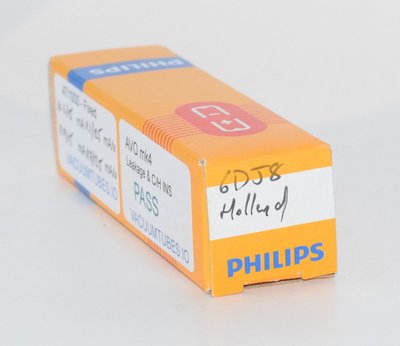
- Testing: Proper testing on a calibrated tube tester (such as a Hickok or Amplitrex AT1000) for transconductance, matching, noise, and shorts is essential when purchasing premium vintage tubes.
Current Production
For those who prefer not to invest in increasingly scarce and expensive vintage tubes, several manufacturers produce new 6DJ8/ECC88/6922 tubes:
- JJ Electronic (Slovakia): Produces the E88CC, which is widely available and offers good performance at a reasonable price.
- Electro-Harmonix (Russia): Produces the 6922EH, a popular and affordable current-production option.
- Genalex Gold Lion (Russia, reissue): Produces a 6922 that is generally well-regarded in the audio community.
- Tung-Sol (Russia, reissue): Produces a 6922 reissue.
While current-production tubes are perfectly serviceable and represent excellent value, many audiophiles maintain that the best vintage examples — particularly from the Philips/Amperex Heerlen factory and Siemens — offer a level of refinement, dimensionality, and musical engagement that current production has not yet fully replicated.
Practical Advice for Audio Use
- Always check your equipment's operating voltages before substituting a 6DJ8/ECC88 for a 6922/E88CC. The 6DJ8's 130 V plate voltage limit is the most critical consideration.
- Use vibration-dampening socket rings (such as Herbie's Tube Dampers) to minimize microphonic effects, especially in phono stages and high-gain circuits.
- Allow adequate warm-up time — the 6DJ8 typically reaches stable operating conditions within 2–5 minutes, but many audiophiles report that the tube sounds best after 20–30 minutes of warm-up.
- Match pairs carefully for balanced/differential circuits. Matched pairs should have transconductance values within 5–10% of each other for best performance.