1. Introduction and History
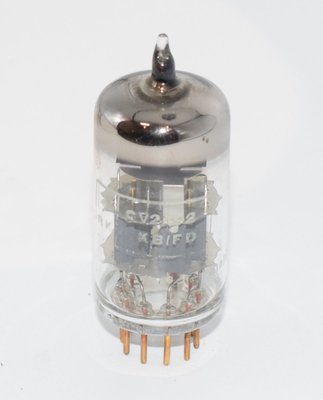
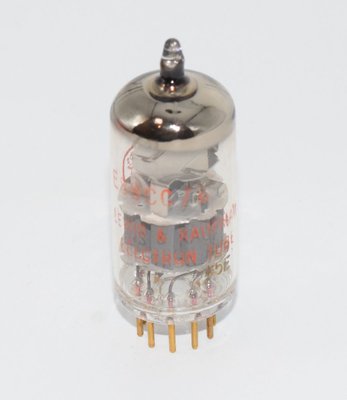
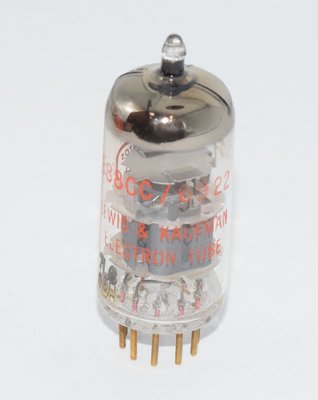
The E88CC is a high-frequency, special-quality double triode with separate cathodes, originally developed in the late 1950s for demanding professional applications in telecommunications, television receivers, and instrumentation. The European Pro-Electron designation "E88CC" breaks down as follows: "E" denotes a 6.3V heater supply, "88" is the type identifier, and "CC" signifies a special-quality (long-life, tight-tolerance) version of the base ECC88 design. Its American RETMA equivalent is the 6922.
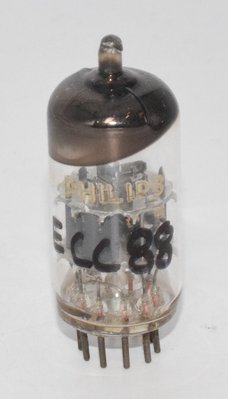
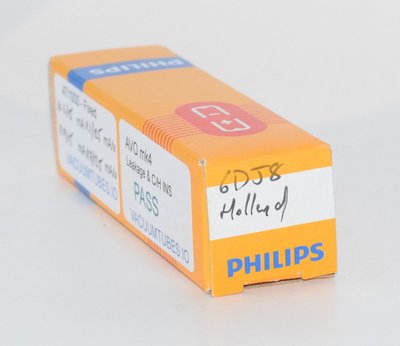
The tube was manufactured by virtually every major European and American valve maker, including Philips/Amperex (Holland and USA), Siemens & Halske, Telefunken, Mullard, Valvo, and Tesla (Czechoslovakia). The attached Tesla datasheet, dated 26 April 1960, provides one of the earliest comprehensive published specifications for this type. Tesla explicitly states that their E88CC replaces the foreign type 6922.
The "CC" special-quality designation imposed stringent requirements that set the E88CC apart from the standard ECC88/6DJ8. Per the Tesla datasheet, these include:
- Long-duration vibration resistance: 96 hours at 2.5g acceleration, 50 c/s
- Single-shock resistance: 500g for 1 ms duration
- Multiple-shock resistance: 5000 shocks at 12g
- Continuous centrifugal acceleration: 12g
- Tight parameter tolerances
- Guaranteed long life (rated as a mean value across 100 tubes)
- Operational reliability
Originally intended for cascode RF amplifier stages in television tuners, mixer/oscillator circuits, pulse amplifiers, phase inverters, and multivibrators, the E88CC found a second life beginning in the 1980s and 1990s as a premium audio tube. Today it is one of the most sought-after small-signal tubes in high-end audio, with vintage examples from Amperex, Siemens, and Telefunken commanding substantial prices on the collector market.
2. Technical Specifications and Design
General Construction
| Tube Type | High-frequency double triode (dual triode) with separate cathodes |
| Cathode | Indirectly heated, oxide-coated |
| Envelope | All-glass miniature (9-pin) |
| Base | Noval (B9A), 9-pin miniature |
| Internal Shielding | Both triode systems are individually shielded internally; each shield is brought out to a separate pin on the base |
| Pin Connections (gold-plated) | See pinout section below |
| Weight | Max 12 g |
| Maximum Bulb Diameter | 22.2 mm |
| Overall Height | 56.3 mm (seated height from base) |
| Socket | S 9/12 per ČSN 35 8904 |
Heater Data
| Heater Voltage (Uf) | 6.3 V (min 6.0 V, max 6.6 V) |
| Heater Current (If) | 0.3 A (per section; both sections heated in parallel) |
| Heater Supply | AC or DC, parallel connection |
Interelectrode Capacitances (System I)
| Parameter | Symbol | Value |
|---|---|---|
| Grid to Cathode + Heater + Shield | Cg1/k1+f+s | 3.1 ± 0.6 pF |
| Grid to Cathode + Heater | Cg1/k1+f | 3.1 ± 0.6 pF |
| Grid to Anode (Cga) | Cg1/a1 | 1.4 ± 0.2 pF |
| Anode to Cathode (Cak) | Ca1/k1 | 0.18 ± 0.4 pF |
| Anode to Shield | Ca1/s | 1.3 ± 0.2 pF |
| Cathode to Heater | Ck1/f | 2.6 ± 0.5 pF |
| Anode to Grid + Heater + Shield | Ca1/g1+f+s | 3 ± 0.3 pF |
| Cathode to Grid + Heater + Shield | Ck1/g1+f+s | 6 ± 0.9 pF |
System II capacitances are closely matched to System I, with typical values within 0.1 pF. For example, Ca2/k2+f+s = 1.65 ± 0.2 pF, Cg2/a2 = 1.4 ± 0.2 pF.
Inter-System Isolation Capacitances
| Anode I to Anode II | Ca1/a2 | < 0.045 pF |
| Grid I to Grid II | Cg1/g2 | < 0.005 pF |
| Anode I to Grid II | Ca1/g2 | < 0.005 pF |
| Anode II to Grid I | Ca2/g1 | < 0.005 pF |
| Grid I to Cathode II | Cg1/k2 | < 0.005 pF |
| Grid II to Cathode I | Cg2/k1 | < 0.005 pF |
Characteristic Data (per section)
| Parameter | Symbol | Condition 1 | Condition 2 |
|---|---|---|---|
| Anode Supply Voltage | Uba | 90 V | 100 V |
| Grid Bias Voltage | Ug1 | 0 V | +9 V (via cathode resistor) |
| Cathode Resistor | Rk | 120 Ω | 680 Ω |
| Anode Current | Ia | 12 mA | 15 ± 0.8 mA |
| Transconductance (gm) | S | 11.5 mA/V | 12.5 (+2.5/−2) mA/V |
| Amplification Factor | μ | 33 ± 5 | |
| Anode Cutoff Current (Ua=90V, −Ug=4V) | Iaz | < 1 mA | |
| Equivalent Noise Resistance (f=45 MHz) | Req | 300 Ω | |
| Grid Current Onset Voltage (Ig1=+0.3 μA) | Ug1 ef | 0.75 V | |
| Noise Figure (cascode, f=200 MHz) | F | 4.6 dB | |
Characteristic Data for Computer Applications
| Anode Supply Voltage | Uba | 150 V |
| External Anode Resistor | Ra | 2.5 kΩ |
| Grid Circuit Resistor | Rg1/a | 300 kΩ |
| Anode Current | Ia | 33 ± 5 mA |
| Anode Current (Uba=60V) | Ia | > 9 mA |
| Cutoff Voltage (Iaz=100 μA) | Ug1 | −6.5 (+2/−1.5) V |
| Cutoff Voltage (Iaz<5 μA) | Ug1 | −15 V |
Mixer/Oscillator Operating Data
| Parameter | Symbol | Ub=50V | Ub=90V | Ub=150V |
|---|---|---|---|---|
| External Anode Resistor (capacitively bypassed) | Ra | 0 kΩ | 1 kΩ | 4 kΩ |
| Grid Leak Resistor | Rg1 | 1 MΩ | 1 MΩ | 1 MΩ |
| Oscillator Drive Voltage | Uosc ef | 2 V | 2.5 V | 3 V |
| Anode Current | Ia | 4.7 mA | 7.7 mA | 11 mA |
| Conversion Transconductance | Sc | 2.9 mA/V | 3.5 mA/V | 4.1 mA/V |
| Internal Resistance | Ri | 8.3 kΩ | 7 kΩ | 6.1 kΩ |
Class A Amplifier Data (Single System)
| Anode Voltage | Ua | 220 V |
| External Anode Resistor | Ra | 20 kΩ |
| Grid Bias | Ug1 | −6.8 V |
| Quiescent Anode Current | Ia0 | 6.5 mA |
| Anode Current at Full Drive | Ia | 9.2 mA |
| AC Drive Voltage | Ug1 ef | 4.5 V |
| Output Power | Po | 0.5 W |
| Distortion | k | 7% |
| Drive for 50 mW Output | Ug1 ef | 1.5 V |
Push-Pull Class B Amplifier Data (Both Systems)
| Parameter | Symbol | Condition A | Condition B |
|---|---|---|---|
| Anode Voltage | Ua | 200 V | 200 V |
| Anode-to-Anode Load Resistance | Ra-a | 22 kΩ | 10 kΩ |
| Grid Bias | Ug1 | −6 V | −6 V |
| Quiescent Anode Current | Ia0 | 2 × 5 mA | 2 × 5 mA |
| Anode Current at Full Drive | Ia | 2 × 9 mA | 2 × 13.5 mA |
| AC Drive Voltage | Ug1 ef | 4 V | 4 V |
| Output Power | Po | 1.2 W | 1.5 W |
| Distortion | k | 3% | 4% |
| Drive for 50 mW Output | Ug1 ef | 0.9 V | 0.9 V |
Condition A = continuous sinusoidal drive; Condition B = music/speech modulation drive.
Absolute Maximum Ratings (per section)
| Parameter | Symbol | Max Value |
|---|---|---|
| Anode Voltage (cold, no current) | Ua0 | 550 V |
| Anode Voltage (Ia=0) | Ua | 400 V |
| Anode Voltage (operating) | Ua | 220 V |
| Anode Voltage (Wa ≤ 0.8 W) | Ua | 250 V |
| Anode Dissipation | Wa | 1.5 W |
| Combined Anode Dissipation (note 5) | Wa1+Wa2 | ≤ 2 W (max 1.8 W total) |
| Negative Grid Voltage | −Ug1 | 100 V |
| Negative Grid Voltage (peak) | −Ug1 peak | 200 V |
| Grid Dissipation | Wg1 | 0.03 W |
| Cathode Current | Ik | 20 mA |
| Peak Cathode Current | Ik peak | 100 mA (max 10% duty, ≤ 0.2 ms) |
| Grid Leak Resistance | Rg1 | 1 MΩ |
| Cathode-to-Heater Voltage (K positive) | U+k/f− | 120 V |
| Cathode-to-Heater Voltage (K negative) | U−k/f+ | 60 V |
| External Cathode-to-Heater Resistance | Rk/f | 20 kΩ |
| Bulb Temperature | Tb | 170°C |
| Heater Voltage Range | Uf | 6.0 V min, 6.6 V max |
End-of-Life Parameters
| Anode Current | Ia | > 13.5 mA |
| Transconductance | S | > 9 mA/V |
| Reverse Grid Current | −Ig1 | < 1 μA |
| Interelectrode Leakage | Iis | < 7 μA |
| Heater-Cathode Leakage | I+k/f− | < 12 μA |
| Heater-Cathode Leakage | I−k/f+ | < 12 μA |
Pinout (Noval B9A base, bottom view)
| Pin | Function |
|---|---|
| 1 | Anode I (a1) |
| 2 | Grid I (g1) |
| 3 | Cathode I (k1) |
| 4 | Heater (f) |
| 5 | Heater (f) |
| 6 | Anode II (a2) |
| 7 | Grid II (g2) |
| 8 | Cathode II (k2) |
| 9 | Internal Shield (s) — connected to shield between sections |
Note: The internal shield (pin 9) should typically be connected to ground or to the cathode circuit for optimal performance and lowest crosstalk between sections.
3. Applications and Usage
The E88CC was originally designed for professional and military-grade electronic equipment. The Tesla datasheet explicitly lists the following intended applications:
- Television receiver front-ends: Cascode RF amplifier stages in VHF/UHF tuners, where the low noise figure (4.6 dB at 200 MHz) and low interelectrode capacitances were essential
- Pulse amplifiers: The high transconductance and tight tolerances made it ideal for pulse circuits in radar and instrumentation
- Mixer/oscillator circuits: Detailed operating data is provided for supply voltages from 50V to 150V
- Phase inverters: The matched dual-triode construction with excellent inter-section isolation (<0.005 pF grid-to-grid) made it a natural choice
- Multivibrators and switching circuits: Computer applications data is specifically provided in the Tesla datasheet, with 150V supply, 2.5 kΩ anode resistor, and 300 kΩ grid resistor
- High-frequency amplification: The "Vysokofrekvenční" (high-frequency) designation in the Tesla datasheet title underscores this primary purpose
The special-quality construction — with its resistance to vibration (2.5g for 96 hours), shock (500g single impact), and centrifugal acceleration (12g continuous) — made the E88CC suitable for mobile, airborne, and shipboard equipment where standard commercial tubes would fail.
In modern times, the E88CC has found extensive use in:
- High-end audio preamplifiers and line stages
- Headphone amplifiers
- DAC output stages (tube buffer stages)
- Phono preamplifiers (RIAA stages)
- Guitar amplifier clean channels (less common than 12AX7 but used in some boutique designs)
- Professional studio microphone preamplifiers
- Test and measurement equipment (oscilloscopes, voltmeters)
4. Sound Characteristics
The E88CC / 6922 family has developed a strong reputation in the audiophile community for its distinctive sonic qualities. While sound perception is inherently subjective and heavily dependent on circuit design, component quality, and operating point, there is broad consensus among experienced listeners and designers on several characteristics:
General Sonic Signature
The E88CC is widely regarded as one of the most transparent and revealing small-signal triodes available. Its high transconductance (12.5 mA/V) and moderate amplification factor (μ = 33) give it a fundamentally different character from higher-μ types like the 12AX7 (μ ≈ 100). The lower gain means less feedback is typically needed in the surrounding circuit, and the tube operates with greater linearity at typical audio signal levels.
Key Sonic Attributes
- Detail and Resolution: The E88CC is consistently praised for its ability to resolve fine musical detail. The low equivalent noise resistance (300 Ω at 45 MHz per the Tesla datasheet) translates to a quiet noise floor that allows subtle musical information to emerge. Listeners frequently describe the tube as "revealing" and "articulate."
- Midrange Clarity: The midrange is typically described as open, clear, and slightly forward without being aggressive. Vocals and acoustic instruments are rendered with excellent presence and natural tonal color.
- Bass Response: The relatively low plate resistance and high transconductance contribute to tight, well-controlled bass. Compared to higher-impedance triodes, the E88CC can drive subsequent stages or coupling networks with greater authority in the low frequencies.
- Treble Character: The high-frequency extension is excellent — unsurprising given the tube's RF heritage. The treble is typically described as extended, airy, and detailed without excessive brightness, though this varies significantly between manufacturers.
- Soundstage: The E88CC is known for presenting a wide, deep soundstage with precise imaging. The excellent inter-section isolation (<0.005 pF between grids) contributes to channel separation when both triode sections are used in a stereo configuration.
- Dynamic Response: The high transconductance allows the tube to respond quickly to transient signals, giving it a lively, dynamic quality that many listeners find engaging.
Manufacturer-Specific Sound Variations
Audiophiles have long noted significant sonic differences between E88CC tubes from different manufacturers, even though all meet the same electrical specifications:
- Amperex (Holland — Heerlen plant): Often considered the gold standard. Known for a rich, warm midrange with excellent dimensionality. The famous "orange globe" and "Bugle Boy" labeled versions are among the most prized audio tubes ever made. Early gold-pin examples from the mid-to-late 1950s are particularly coveted.
- Amperex (USA — New York): Slightly different character from the Dutch production. Still warm and musical but with perhaps a touch more detail and slightly less midrange lushness. The 1955 and 1958 vintage gold-pin examples are highly sought after.
- Siemens & Halske: Renowned for precision, detail, and a slightly more analytical presentation. Excellent transient response and a very clean, extended top end. The Siemens E88CC is often preferred in systems that benefit from maximum resolution.
- Telefunken: Combines the warmth of Amperex with the precision of Siemens. Often described as the most "musical" and balanced of the premium E88CC variants. Diamond-bottom versions are especially prized.
- Mullard: Warm, smooth, and slightly romantic. Excellent for systems that tend toward brightness.
- Tesla: The Czechoslovak-made Tesla E88CC offers good performance at a more accessible price point. Generally described as clean and neutral, with good dynamics, though perhaps lacking the last degree of refinement found in the top Amperex or Siemens examples.
5. Equivalent and Substitute Types
Close/Identical Substitutes (Direct Drop-In Replacements)
The following types are electrically identical or nearly identical to the E88CC and can be used as direct replacements without circuit modification:
| Type | Notes |
|---|---|
| 6922 | American RETMA equivalent designation. Electrically identical. |
| 6922WA | Ruggedized/military version of the 6922. Premium quality. |
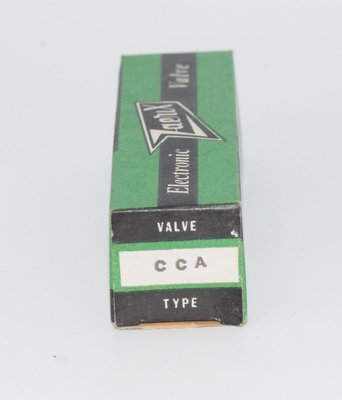
| CCA | Siemens special-quality designation, equivalent to E88CC. Extremely sought-after by audiophiles. |
| CV2492 | British military (CV) designation for E88CC. |
| CV2493 | British military designation, equivalent to E88CC. |
| CV10320 | British military designation, equivalent to E88CC. |
| CV8065 | British military designation, equivalent to E88CC. |
| E88CC-01 | Variant designation, electrically identical. |
| ECC868 | Alternate Philips designation, equivalent to E88CC. |
Different-Rating Substitutes (NOT Direct Drop-In)
The following types share the same pinout and general construction but have different ratings, tolerances, or specifications. They may work in many circuits but are not guaranteed drop-in replacements and may require bias adjustment or other circuit modifications:
| Type | Notes |
|---|---|
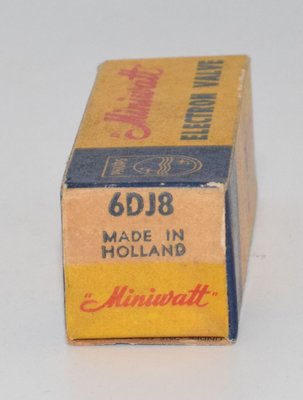
| 6DJ8 / ECC88 | The standard commercial-grade version. Same basic electrical parameters but without the special-quality (CC) tight tolerances, extended life rating, or vibration/shock resistance. Works in most audio circuits designed for E88CC but with wider parameter spread between sections and potentially shorter life. |
| 6N23P (6Н23П) | Soviet equivalent. Similar specifications but manufactured to different standards. Some versions (6N23P-EV) are closer to E88CC quality. Pin-compatible but may have slightly different operating characteristics. |
| CV5358 | British military designation for a related type with different ratings. |
Important Note: The E88CC/6922 should not be confused with or substituted for the 6N1P, E188CC/7308, or other superficially similar types without careful verification of electrical compatibility. The E188CC/7308 is actually an improved, longer-life version of the E88CC with tighter specifications and can generally substitute for the E88CC, but the reverse substitution should be verified against the specific circuit requirements.
6. Notable Characteristics
Exceptional Inter-Section Isolation
One of the E88CC's most remarkable design features is the internal shielding between the two triode sections. The Tesla datasheet specifies inter-system capacitances of less than 0.005 pF for grid-to-grid, anode-to-grid (cross), and grid-to-cathode (cross) measurements. The anode-to-anode capacitance is specified at less than 0.045 pF. This level of isolation is exceptional and makes the E88CC particularly suitable for applications where crosstalk between channels must be minimized, such as stereo preamplifiers using one section per channel.
Microphony Resistance
The Tesla datasheet specifies rigorous microphony testing: at Uf = 6.3V, Ub = 140V, Ia = 5 mA, Ra = 10 kΩ, Rg1 = 0 Ω, the measured voltage at the anode must not exceed 200 μV. This low microphony specification is critical for audio applications, particularly in phono stages where the tube amplifies very small signals from a cartridge.
Vibration Stability
Under vibration conditions (Uf = 6.3V, Ub = 90V, Ra = 2 kΩ, Rk = 100 Ω, Ck = 100 μF, Rg1 = 0 Ω, acceleration 2.5g at 50 c/s), the measured AC voltage across the anode resistor must not exceed 4 mV. This specification ensures stable operation in environments subject to mechanical vibration.
Atmospheric and Temperature Resilience
The E88CC is tested across a temperature range of −60°C to +90°C at 95% relative humidity per ČSN 35 8501, article 162. Under reduced atmospheric pressure conditions (Uf = 6.3V, Ua = 200V, Ug1 = −5V), the tube must operate for 50 hours at 10 minutes altitude equivalent without discharge or anomalous DC current characteristics.
Hum and Noise Performance
The hum specification is tested under demanding conditions: Uf = 6.3V (50 Hz ± 3%), f = 500 Hz, Ub = 240V, Ra = 10 kΩ, Rk = 80 Ω, Ck = 1000 μF, Rg1 = 500 kΩ. The AC ripple voltage must not exceed Ubr = 50 μV. This extremely low hum specification makes the E88CC suitable for high-gain, low-noise audio applications.
Gold-Plated Pins
The Tesla datasheet notes that the base pins are gold-plated ("Kolíky elektronky jsou zlaceny"). This is a standard feature of the E88CC specification across all manufacturers, providing reliable, low-resistance contact and resistance to oxidation — particularly important in professional equipment where tubes may remain in service for years.
Matched Section Performance
The tight tolerances specified for the E88CC (anode current 15 ± 0.8 mA, transconductance 12.5 +2.5/−2 mA/V, μ = 33 ± 5) ensure that the two triode sections within a single envelope are closely matched. This is essential for balanced/differential circuits, phase splitters, and stereo applications where section-to-section matching directly affects performance.
7. Usage in the Audio Community
Historical Context
The E88CC's migration from professional electronics into high-end audio began in earnest during the 1980s, as designers recognized that its exceptional specifications — low noise, high linearity, tight tolerances, and robust construction — made it an ideal candidate for audiophile preamplifier designs. The tube's moderate gain (μ = 33) proved well-suited to line-stage applications where the higher gain of a 12AX7 (μ ≈ 100) was unnecessary and potentially detrimental to linearity.
Prominent Audio Equipment Using E88CC / 6922
The E88CC / 6922 has been adopted by many of the most respected names in high-end audio:
- Audio Research: Numerous preamplifiers including the SP-series and LS-series line stages
- Conrad-Johnson: Various preamplifier designs
- Sonic Frontiers / Anthem: SFL-1, SFL-2 preamplifiers and others
- BAT (Balanced Audio Technology): VK-series preamplifiers
- Aesthetix: Calypso and other preamplifiers
- Manley Labs: Various designs
- Rogue Audio: Multiple preamplifier models
- Schiit Audio: Lyr headphone amplifier series and Freya preamplifier
- Bottlehead: Various DIY kit designs
- EAR (Esoteric Audio Research): Yoshino designs by Tim de Paravicini
Headphone Amplifier Applications
The E88CC has become particularly popular in the headphone amplifier segment. Its high transconductance (12.5 mA/V) and relatively low plate resistance make it capable of driving headphones with good authority, either directly in OTL (Output Transformerless) designs or as a voltage gain stage. The tube's low noise floor is especially appreciated in headphone listening, where the intimate nature of the experience makes any noise or hum immediately apparent.
Phono Stage Applications
With its low equivalent noise resistance (300 Ω) and excellent microphony specifications (≤ 200 μV), the E88CC is a strong candidate for phono preamplifier input stages. The moderate gain is well-suited to moving-magnet cartridge amplification, and the tube's linearity helps preserve the delicate musical information encoded in vinyl grooves.
The NOS (New Old Stock) Market
The E88CC is one of the most actively traded tubes on the vintage/NOS market. Prices vary enormously depending on manufacturer, vintage, and condition:
- Premium tier: Amperex (Holland) "Bugle Boy" and "Orange Globe" E88CC, Telefunken E88CC with diamond bottom, Siemens CCA — these can command $100–$400+ per tube for tested, guaranteed examples
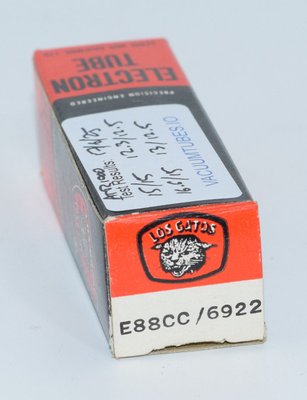
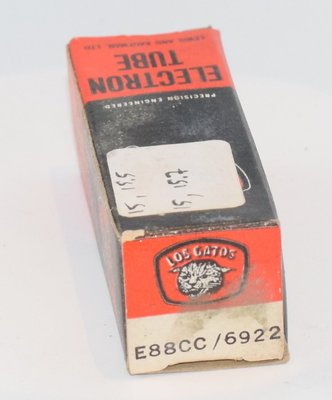
- Mid tier: Amperex USA production (including those later rebranded as "Los Gatos" by Lewis & Kaufman of Los Gatos, California), Mullard, Valvo — typically $50–$150 per tube
- Entry tier: Tesla, Ei (Yugoslavia), later Philips production, current production (JJ, Electro-Harmonix, Genalex Gold Lion reissue) — typically $15–$50 per tube
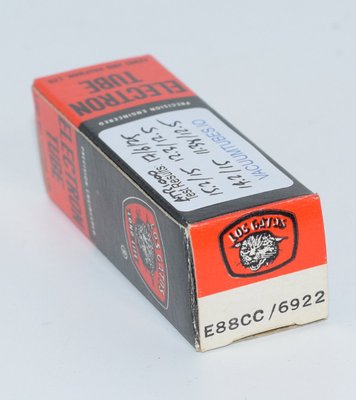
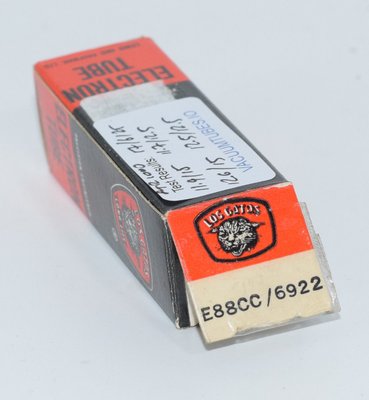
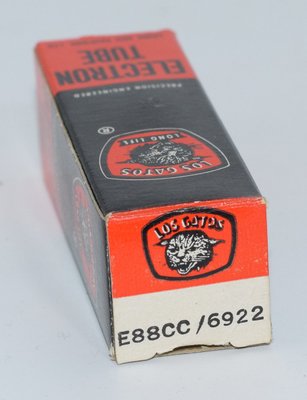
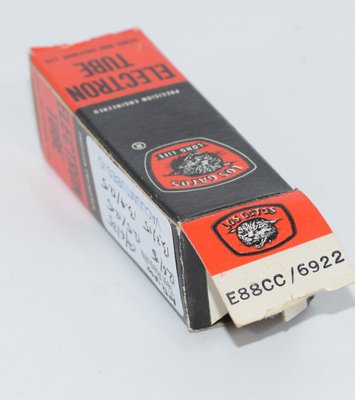
It is worth noting the "Los Gatos" brand that appears on some NOS E88CC/6922 tubes. Los Gatos was not a tube manufacturer but a private label used by Lewis & Kaufman, based in Los Gatos, California. In the early 1980s, they purchased New Old Stock tubes from manufacturers such as Amperex and Siemens, then reboxed and restamped them with the "Los Gatos" name. Los Gatos-branded E88CC/6922 tubes are therefore genuine Amperex, Siemens, or other manufacturer production and should be evaluated based on their actual factory of origin, which can typically be identified by internal construction details and factory codes.
Tube Rolling
"Tube rolling" — the practice of swapping different tube brands and vintages to alter the sound of a component — is perhaps more popular with the E88CC/6922 than with any other tube type. The wide variety of manufacturers, the significant sonic differences between brands, and the large number of audio components using this tube type have created a vibrant community of enthusiasts who meticulously compare and document the sonic characteristics of different E88CC variants.
When tube rolling E88CC types, users should be aware that:
- Only genuine E88CC/6922 or equivalent types (CCA, CV2492, etc.) should be used in equipment specifically designed for this tube
- The standard ECC88/6DJ8 may work but lacks the tight tolerances and may have shorter life
- The E188CC/7308 is an upgraded version and is generally safe to use in E88CC circuits
- Russian 6N23P types may have slightly different characteristics and should be tested for compatibility
- Current-production tubes from JJ, Electro-Harmonix, Genalex (New Sensor), and others provide affordable alternatives to increasingly scarce and expensive NOS tubes
Circuit Design Considerations for Audio
Audio designers working with the E88CC should note several important specifications from the Tesla datasheet:
- The maximum anode dissipation is 1.5 W per section, with a combined limit of approximately 2 W for both sections. This must be respected to ensure long tube life.
- The maximum operating anode voltage is 220V (or 250V if dissipation is kept below 0.8W). Many audio circuits operate the E88CC at 150–200V on the plate.
- The grid leak resistance maximum is 1 MΩ. Exceeding this can lead to grid current issues and shortened tube life.
- The cathode-to-heater voltage limits (120V positive, 60V negative) must be observed in circuits with elevated cathode voltages.
- For lowest noise, the heater should be powered by DC or by AC with a center-tapped winding referenced to a positive bias voltage.